Post Your Faceless Videos When Your Audience Is Actually Watching
The best times to post faceless videos on YouTube Shorts, TikTok and Instagram Reels, why the first hour decides your reach, and how to automate it so you never watch the clock.

Stefano Ventrudo
CTO at Faceless Lab
***The best posting times for faceless videos *on YouTube Shorts, TikTok and Instagram Reels right now, why the first hour decides your reach, and how to make the timing automatic.
So what is the best time to post faceless videos, and does the hour still matter when the algorithm is supposed to show good content to everyone eventually? It matters more than most creators expect. We run faceless channels every day, and the exact same video can pull two or three times the reach depending on when it goes out. The reason is not magic. Short-form platforms watch how people react in the first hour after you publish, and they use that early signal to decide how far to push the video.
Executive Summary. The best time to post faceless videos in 2026 lines up with when your own audience is scrolling, not with one universal magic hour. Recent studies point to clear starting windows: YouTube Shorts do well on weekday late mornings and mid-afternoons, TikTok peaks in the evening from roughly 6pm to 8pm with Sunday and Monday strong, and Instagram Reels perform best early in the morning and again around 7pm to 9pm, all in your audience's local time. Those windows are only a starting point, and your own data decides the rest. Your analytics, a steady posting rhythm and letting a tool publish for you at the right moment will beat chasing any chart. Inside Faceless Lab you batch videos and schedule them to publish automatically, so the best time becomes a setting you pick once instead of an alarm you fight every day.
Table of Contents
- Why posting time still moves the needle on short-form
- The best time to post faceless videos on each platform
- Your audience clock beats any global chart
- How to find your own best posting time
- Schedule it once inside Faceless Lab
- Where timing helps and where it doesn't
1. Why posting time still moves the needle on short-form
A lot of creators assume the algorithm has made timing irrelevant. Post whenever, the machine sorts it out. That is half true and it costs people reach every week.
Here is what actually happens. When you publish, the platform shows your video to a small test pool. It then reads the early reaction, watch time, replays, likes, shares, comments, inside roughly the first thirty to sixty minutes. If that signal is strong, it widens the audience. If it is weak, the video stalls. This is why the same Short can flop at 3am and take off at 4pm.
The early window is a velocity test. Posting when your audience is awake and scrolling stacks the deck, because real viewers are there to give a real signal instead of a silent test pool at a dead hour.
For faceless creators this compounds. We post on volume, often daily, sometimes several times a day. A small timing edge on one video is a rounding error. The same edge across thirty videos a month is the difference between a channel that creeps and one that climbs.
2. The best time to post faceless videos on each platform
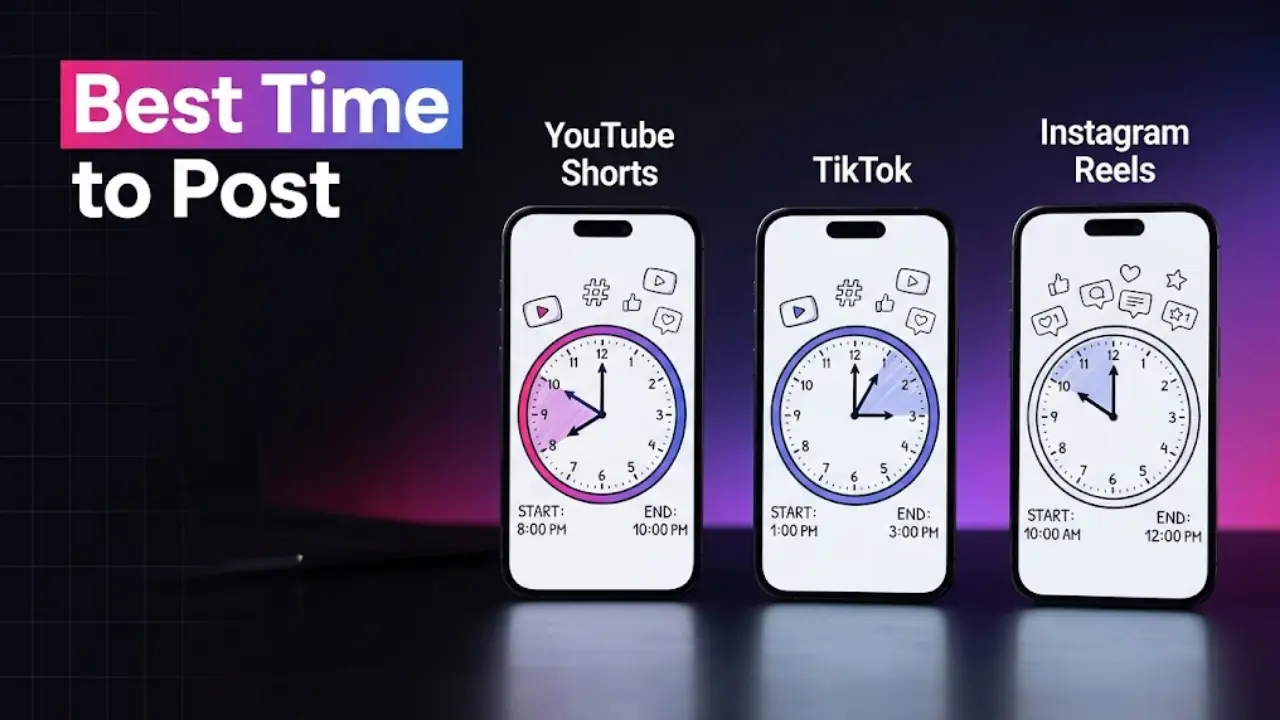
Different platforms, different rhythms. The windows below come from recent 2026 posting studies and match what we see on our own channels. Treat them as strong starting points, and read every time as your audience's local time, not yours.
YouTube Shorts
- Best window: weekday late mornings and mid-afternoons. Tuesday around 11am to 12pm tests well, and the 2pm to 6pm block is reliable across Monday to Thursday.
- Top single slots: Tuesday at 4pm and Wednesday at 3pm.
- Avoid: late Friday and Sunday morning, which tend to see the lowest watch time per Short.
TikTok
- Best window: evening, roughly 6pm to 8pm.
- Top days: Sunday evening, then Monday.
- Extra windows that work: 7am to 9am, 12pm to 2pm and the long 7pm to 11pm stretch when people wind down.
Instagram Reels
- Best window: early morning, around 6am to 9am, is the sweet spot, and 8pm stands out for raw views.
- Top single slots: Thursday and Sunday between 7pm and 9pm show the strongest engagement.
3. Your audience clock beats any global chart
Every chart you just read, including ours, describes an average creator talking to an average audience. You are not average, and that is good news.
Three things bend these numbers for your channel. Where your viewers live is the big one. If most of your audience sits in the US but you post on European time, a "perfect" 6pm slot can land at 3am for the people who matter. Your niche shifts the clock too. A sleep and meditation channel does its best work late at night, a motivation channel catches people first thing in the morning, and a finance channel often lands at lunch and after market close. Your own history is the tiebreaker, because your last fifty uploads already know more about your audience than any industry study.
So use the platform windows to start, then let your analytics overrule them. The chart gets you in the right neighbourhood. Your data finds the right door.
4. How to find your own best posting time
You do not need a spreadsheet or a course for this. You need two weeks and a little discipline.
Step 1: read the free data you already have
Every platform hands you the answer. YouTube Studio shows "when your viewers are on YouTube." Instagram Insights shows your followers' most active hours. TikTok analytics shows follower activity by day and hour. Open all three and write down the two busiest windows for each.
Step 2: test two windows, not ten
Pick your single best window and one backup. Post to the same window every day for a week, then switch to the backup for the next week. Keep everything else the same so the time is the only thing changing.
Step 3: compare the first hour, not the lifetime
Look at views and watch time in the first hour after posting, since that is the signal the algorithm reads. The window that consistently gets a faster start is your winner.
Step 4: lock it in and keep the rhythm
Once you know your window, protect it. A steady daily slot trains both the algorithm and your audience to expect you. Consistency at a decent hour beats jumping around chasing a perfect one.
5. Schedule it once inside Faceless Lab
This is the part that makes timing painless. You should never have to be awake and online at 4pm every day to hit your window. Here is how we set it up inside Faceless Lab.
- Create your videos in a batch. Turn your topics or scripts into finished faceless videos, with voiceover, visuals, music and captions, in one session. A week or a month at a time.
- Connect your platforms. Link your YouTube, Instagram, Facebook and LinkedIn accounts so the videos can publish straight from the app.
- Pick the slot that matches your window. For each video, set the date and time to the best window you found in section 4. Schedule Monday's Short for Tuesday 4pm, and so on.
- Let it publish on its own. Faceless Lab posts each video automatically at the time you chose, so your channel stays active even on the days you are offline.
- Put it on Autopilot or run a Series. For a hands-off channel, use Series to keep one theme producing on a schedule, and Autopilot, currently in beta, to keep the pipeline moving with less manual input.
One honest note on TikTok. Fully automatic publishing there is excluded, because TikTok requires your explicit consent for each post, so that one stays a quick manual step while the rest of your platforms run themselves.
6. Where timing helps and where it doesn't
We would rather tell you the truth than oversell a posting chart.
Timing multiplies what you already have. It can add a real lift on top of a good video, and it can rescue a borderline one by giving it a faster start. What it cannot do is save a weak hook or a boring first three seconds. A strong faceless video at a mediocre hour will almost always beat a weak one posted at the "perfect" minute.

Two more honest limits. If your channel is new, your analytics are thin, so lean on the platform windows until you have enough uploads to trust your own data. And do not let timing become procrastination. We have watched creators sit on finished videos waiting for the ideal slot. A posted video at a decent hour grows your channel. A perfect video still sitting in drafts does nothing.
If you only take one thing from this section, make it this. Fix your hook and your consistency first, then use timing to squeeze out the extra reach.
So, the best time to post faceless videos is the window when your specific audience is actually watching, anchored by the platform averages and confirmed by your own analytics. Find it once, then make it automatic so you can put your energy back into ideas and hooks instead of the clock. Start free, batch your next week of videos and let them publish themselves at the right moment. If a post takes off, reshare it across your other platforms, and if you want to earn while you grow, our affiliate program pays you for creators you bring in. Try it today at facelesslab.video.
Frequently asked questions
What is the best time to post faceless videos in 2026?
There is no single magic hour, but strong starting windows hold across platforms. YouTube Shorts do well on weekday late mornings and mid-afternoons, with Tuesday around 11am to 12pm and the 2pm to 6pm block performing reliably. TikTok peaks in the evening from about 6pm to 8pm, with Sunday and Monday strong. Instagram Reels perform best early in the morning, around 6am to 9am, and again around 7pm to 9pm. Read every time as your audience's local time. Use these as a starting line, then let your own analytics confirm the window that gets your videos the fastest first hour.
Does posting time still matter if the algorithm pushes good content anyway?
Yes, because the algorithm decides how hard to push based on your video's first hour. When you publish, the platform shows the video to a small test pool and reads the early reaction through watch time, replays, likes, shares and comments. A strong signal widens your audience, a weak one stalls the video. Posting when your audience is awake and scrolling means real viewers are there to give that signal, instead of a near-empty test pool at a dead hour. For faceless creators posting daily, that small timing edge compounds across dozens of videos a month.
How do I find the best posting time for my own channel?
Use the free data each platform already gives you. YouTube Studio shows when your viewers are on YouTube, Instagram Insights shows your followers' most active hours, and TikTok analytics shows follower activity by day and hour. Note your two busiest windows, then test. Post to your top window every day for one week, switch to your backup window the next, and keep everything else the same. Compare views and watch time in the first hour after posting, since that is the signal that matters. Whichever window gets a faster start is your winner.
Can I schedule faceless videos to post automatically?
Yes. Inside Faceless Lab you create your videos in a batch, connect your YouTube, Instagram, Facebook and LinkedIn accounts, then set each video to publish at the time you choose. The app posts automatically, so your channel stays active even when you are offline. You can also use Series to keep one theme producing on a schedule and Autopilot, currently in beta, for a more hands-off pipeline. The one exception is TikTok, where fully automatic publishing is excluded because the platform requires your explicit consent for each post.
Is it better to post at the perfect time or to post consistently?
Consistency wins if you have to choose. A steady daily slot at a decent hour trains both the algorithm and your audience to expect you, and it gives you the volume that makes short-form work. The perfect time only adds a bonus on top of that rhythm. Timing multiplies what you already have, so it can lift a good video and give a borderline one a faster start, though it will not rescue a weak hook. Fix your hook and your posting consistency first, then use timing to squeeze out extra reach.
Should I post at the same time on every platform?
No. Each platform has its own rhythm, so a single universal time leaves reach on the table. TikTok leans evening, Instagram Reels lean early morning and late evening, and YouTube Shorts lean weekday daytime. If you repurpose one faceless video across several platforms, space the uploads so each lands in that platform's own best window rather than firing them all at once. This is far easier when your videos are already made and scheduled in advance, so you are only adjusting times instead of producing a fresh upload for each platform on the spot.
Related articles
Make Faceless ASMR Videos Without Recording a Single Sound
Sleep and relaxation content is one of the few niches that stays calm and keeps paying. Here is how to build a faceless ASMR channel with AI voice, visuals and music, no camera and no mic needed.
Start a Faceless Psychology Channel That Turns Everyday Behavior Into Daily Shorts
Psychology is one of the most watchable faceless niches going. Here is how to pick a sub-angle, script hooks that hold attention, and post human-behavior shorts every day without showing your face.
True Crime Is Made for Faceless Video. Here Is How to Do It Right
True crime is one of the most watchable faceless niches, and it does not need your face or voice. Here is how to make faceless true crime videos that hold attention and stay monetizable.