Animal Facts Are the Faceless Niche People Send to Their Friends
Animal facts are one of the easiest faceless niches to start and one of the most shared. Here is how to pick a sub-niche, script shorts that hold, keep every fact accurate, and post daily.

Stefano Ventrudo
CTO at Faceless Lab
How to start a faceless animal facts channel, from picking a sub-niche to scripting, fact-checking and publishing a short every day.
How do you make faceless animal facts videos that people actually watch and share? It is one of the questions we get most from people starting their first channel, and it makes sense. Animals are the rare topic that works for almost every age, every country and every platform, and you never need to show your face or record your voice to cover them. We are Stefano and Roberto, the co-founders of Faceless Lab, and this is the exact way we would build an animal facts channel from zero today.
Executive Summary
Faceless animal facts videos work because curiosity about animals is universal, the format is short, and one surprising fact is enough for a complete video. The channels that grow pick a narrow sub-niche (ocean creatures, weird insects, animal records), open with the strangest detail in the first line, verify every claim against a reliable source, and post on a steady rhythm. With Faceless Lab you can turn a single topic into a scripted, voiced, captioned short with AI visuals and music in minutes, group episodes into a Series and schedule them to YouTube, Instagram, Facebook and LinkedIn, starting from a free trial.
Table of Contents
- Why animal facts work so well as faceless videos
- Pick a sub-niche so viewers know what they are subscribing to
- Write an animal fact short that holds to the last second
- Get the facts right and stay monetizable
- How to make an animal facts short inside Faceless Lab
- Where Faceless Lab is (and is not) the right choice
- Conclusion
1. Why animal facts work so well as faceless videos
Animal facts do most of the work for you. An octopus has three hearts. A group of flamingos is called a flamboyance. Wombats leave cube-shaped droppings. Each of those lines is a hook, a payoff and a reason to share, packed into one sentence.
The format fits short-form perfectly
- One fact equals one video. You never have to stretch a thin idea across a minute. A strong fact plus two supporting details fills 30 to 45 seconds naturally.
- Visuals carry the story. Viewers want to see the animal. That is exactly what AI visuals are good at, and it is why nobody misses a presenter's face.
- It travels across languages. A fact about a mantis shrimp lands the same way in Italian, Spanish or English, so the same idea can feed several channels.
Shares and saves do the heavy lifting
People send animal facts to friends with a "did you know this?" and that is the kind of signal every platform rewards. Comments fill up with people adding their own facts or arguing about whether something is true, which is free engagement you did not have to ask for.
It stays evergreen
A video about how owls turn their heads will still be accurate and interesting in three years. That gives your back catalog a long tail, unlike news or trend content that fades in a week.
2. Pick a sub-niche so viewers know what they are subscribing to
"Animal facts" on its own is too wide to build a channel on. When someone lands on your profile, they should understand in two seconds what they will get if they follow. Here are sub-niches we like, with the type of episode each one produces.
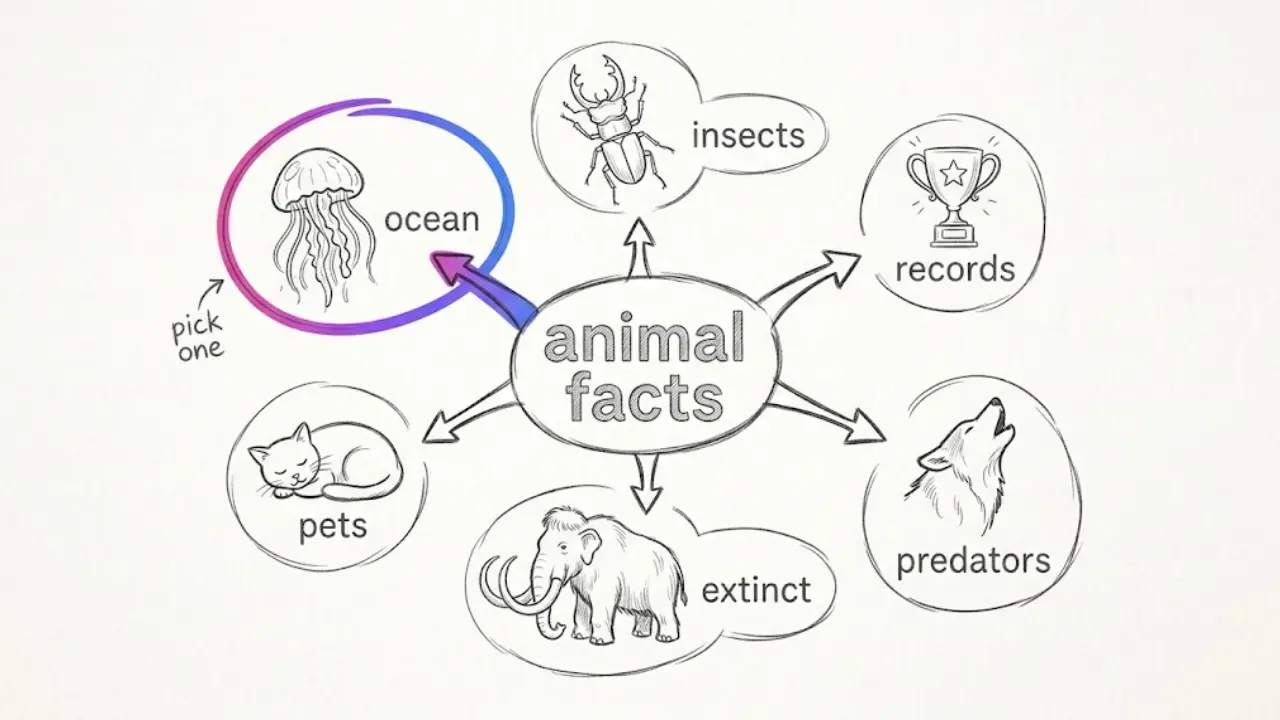
Sub-niches with room to grow
- Deep sea and ocean creatures. Anglerfish, giant squid, bioluminescence. The visuals are strange and beautiful, and there is endless material.
- Weird insects and bugs. Bombardier beetles, praying mantises, ant colonies. A little creepy, which helps retention.
- Animal records. Fastest, strongest, loudest, longest-lived. These slot perfectly into countdown formats.
- Predators and survival. How hunters hunt and how prey escapes. High tension, great for storytelling.
- Prehistoric and extinct animals. Megalodon, mammoths, dodos. Big curiosity, lots of "what if" hooks.
- Pets explained. Why cats knead, why dogs tilt their heads. A huge audience that already owns the subject.
How to choose
Pick the one you would happily research for 100 episodes. That is roughly what it takes to see which videos your audience wants more of. If you cannot list 30 episode ideas in ten minutes, the sub-niche is too narrow. If every idea could belong to any animal channel, it is too broad.
One visual style for the whole channel
Once you choose, lock one look. Realistic nature-documentary visuals suit ocean and predator channels, while a soft illustrated look suits pets and records. Switching style every video makes your channel harder to recognize in the feed.
3. Write an animal fact short that holds to the last second
The fact is the product, and the script is the packaging. Most animal videos lose people because they open with the animal's name and a textbook sentence. Start with the strangest thing instead.
A simple structure that works
- Hook (first line). The most surprising detail, said plainly. "This animal can survive being frozen solid."
- Reveal. Name the animal and show it. "Meet the wood frog."
- How it works. Two or three short lines on the mechanism, in plain words.
- Twist or bonus. One extra detail that raises the stakes. "And it does this every single winter."
- Loop or question. End on a question that sends people to the comments, or a line that flows back into the hook for a rewatch.
Write for the ear
- Keep sentences short enough to say in one breath.
- Replace numbers people cannot picture with comparisons. "As heavy as a small car" beats a figure in kilograms.
- Cut every word that is not doing work. At 30 seconds, you have roughly 75 to 90 spoken words.
Hooks we would test
- "This bird can sleep while it flies."
- "Scientists still argue about how this fish breathes."
- "You have probably seen this animal and never noticed it."
- "The most dangerous animal in this video is the smallest one."
4. Get the facts right and stay monetizable
Animal content has a trust problem. The internet is full of "facts" that are half true or completely made up, and viewers love correcting you in the comments. A channel that gets things wrong loses credibility fast.
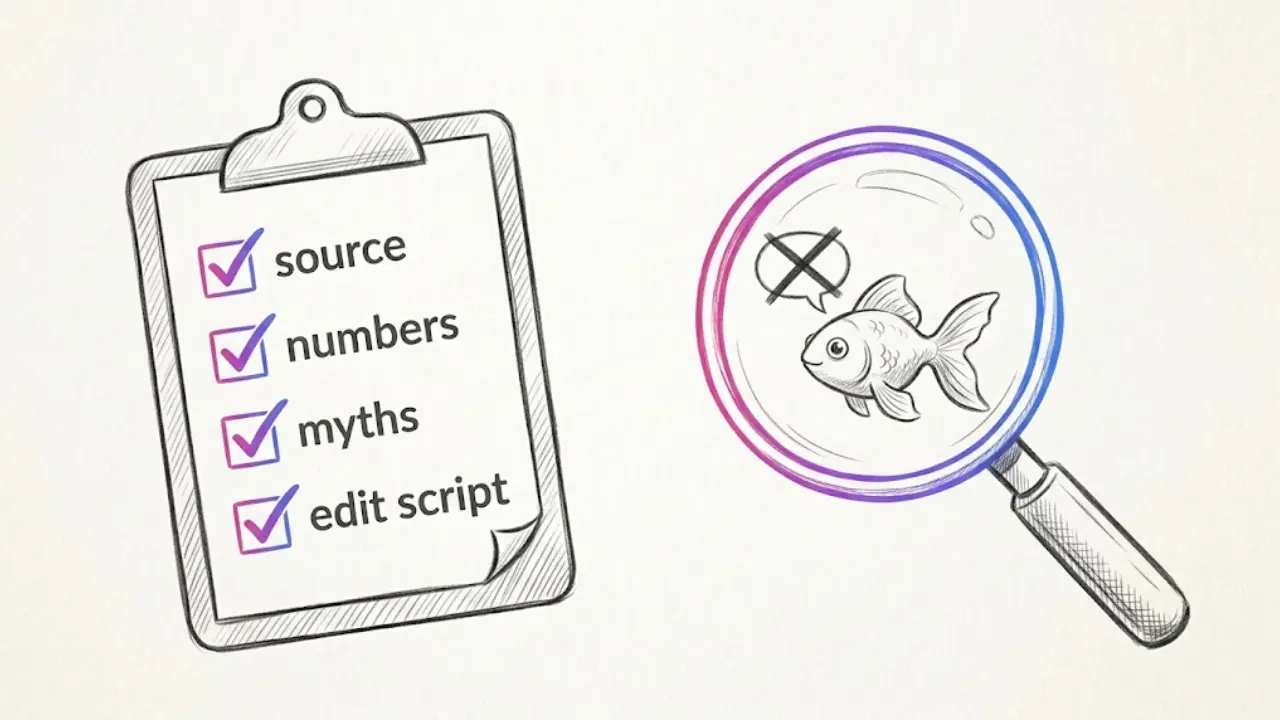
Build a fact-check habit
- Use primary or expert sources. Museum sites, university pages, established nature publishers and the IUCN Red List for conservation status.
- Check every number twice. Speeds, sizes and lifespans vary a lot between sources. When they disagree, say "up to" or give a range.
- Watch for classic myths. Goldfish having a three-second memory and bulls hating the color red are two examples that experts have debunked. They make great "myth vs truth" episodes, as long as you land on the correct side.
- Edit the AI script. An AI draft is a starting point. Read it, check it and fix anything you cannot confirm before you generate.
Keep it original
YouTube's inauthentic content policy targets mass-produced, repetitive uploads, and faceless channels are allowed. What gets flagged is a pile of near-identical videos with the animal name swapped. Vary your structures, write real scripts and give each episode a specific angle, and your channel will feel like a show people come back to.
Think about who you are making it for
Animal videos attract kids. If you make content directed at children, YouTube requires you to mark it as "made for kids", which turns off comments, personalized ads and the notification bell. For most faceless channels, the smarter move is to aim at curious teens and adults with a general-audience tone.
5. How to make an animal facts short inside Faceless Lab
This is the workflow we use, from blank page to scheduled video. It takes minutes per short once your channel settings are in place.
Step 1: Start with one topic
Open the dashboard and type your idea. It can be as short as "the octopus has three hearts" or a full script you already wrote. If you paste your own text, Faceless Lab uses it as the script.
Step 2: Choose a structure
Pick one of the 8 video structures. A countdown works for records ("5 fastest animals on Earth"), a story-style structure works for predators and survival, and a quiz-style format gets people answering in the comments.
Step 3: Review and edit the script
Read the draft, check each fact against your source and tighten the hook. This is the step where your channel earns its credibility, so do not skip it.
Step 4: Pick a voice
Choose from more than 200 ElevenLabs voices. A calm documentary voice suits ocean and prehistoric channels, a brighter voice suits pets. Keep the same voice on every episode so people recognize it.
Step 5: Lock your visual style
Choose one of the 39 visual styles and stick with it. You can also pick which AI image model generates the scenes, since Faceless Lab runs several models through Replicate, which helps when one model renders fur or scales better than another.
Step 6: Captions and music
Captions are generated automatically and you can adjust them. Add background music from the library, where copyright-free tracks are clearly marked.
Step 7: Turn it into a Series and schedule it
Save the setup as a Series so every episode keeps the same voice, style and structure. Then schedule it to publish automatically on YouTube, Instagram, Facebook and LinkedIn. TikTok publishing needs your explicit consent on each post, so it is not fully hands-off there. If you want to go further, Autopilot (currently in beta) can keep a Series running on a rhythm you set.
💡 Ready to try the workflow on your first animal fact? Create your free Faceless Lab account and make one short today.
6. Where Faceless Lab is (and is not) the right choice
We want you on the tool that fits your channel, so here is our honest take.
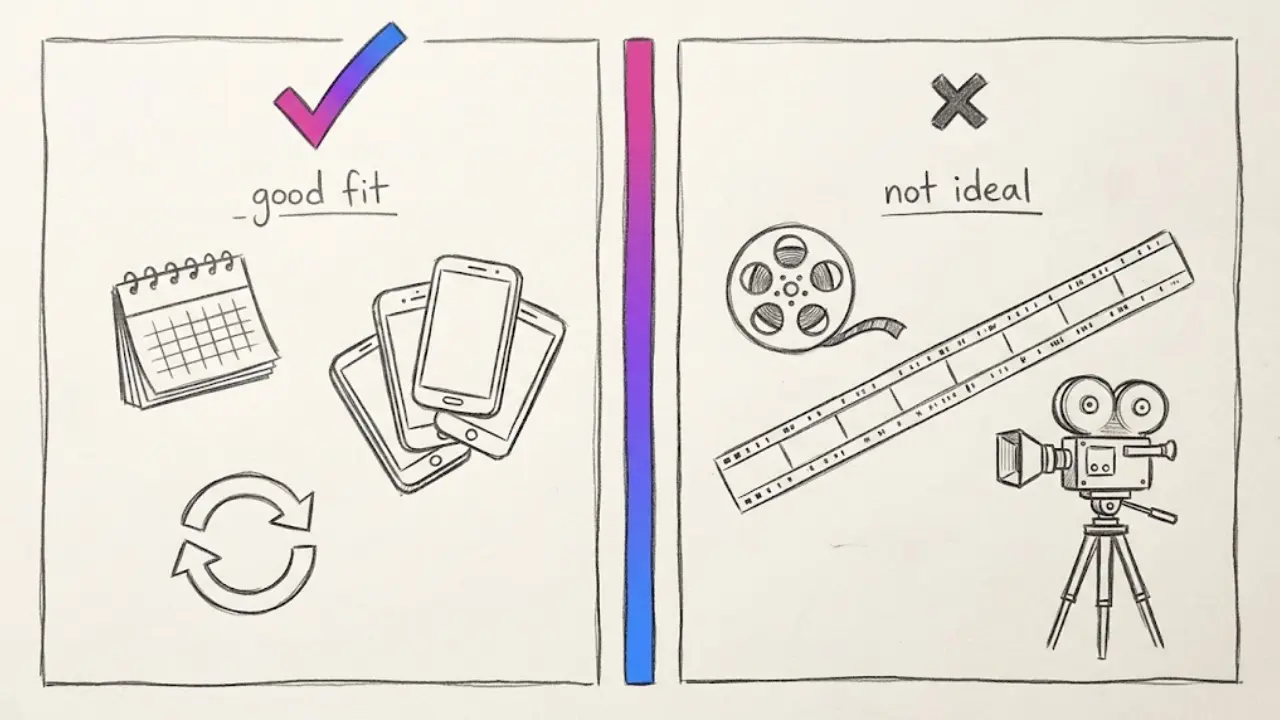
Faceless Lab is a good fit if
- You want to publish animal shorts daily without editing each one by hand.
- You like the idea of a Series that keeps your voice and style consistent.
- You want scheduling and auto-publishing in the same place you create.
- You want to start free and only pay when the channel proves itself. Plans go Free trial €0, Starter €19, Growth €59 and Pro €149 per month.
It is probably not the right choice if
- You want real wildlife footage. Faceless Lab generates AI visuals. If your channel depends on licensed documentary clips, you need a stock footage library and a traditional editor.
- You make long documentaries. We focus on short-form and support videos up to 5 minutes. A 20-minute deep dive needs a different workflow.
- You want frame-by-frame timeline control. If you enjoy keyframing every cut, a full video editor will give you more manual control.
- You are building a channel for young children. "Made for kids" content loses comments and personalized ads, and there is growing scrutiny of AI-made kids videos. That is a decision to make carefully, whatever tool you use.
7. Conclusion
Animal facts are one of the friendliest faceless niches to start. The topic is endless, it is evergreen, and people share it without being asked. The channels that win pick a clear sub-niche, open every short with the strangest detail, check their facts and keep a rhythm they can hold for months.
Our verdict: if you want to test a faceless channel with low risk and high share potential, this is one of the best places to begin. Start with 10 episodes in one sub-niche, look at which ones get saved and shared, and double down on those.
You can make your first animal facts short on the free trial and see how it feels before paying anything. If this guide helped, share it with a friend who keeps saying they will start a channel, and if you already love Faceless Lab, ask us about our affiliate program.
Try Faceless Lab free and make your first animal facts short
Read more
Frequently asked questions
Are faceless animal facts videos still worth starting in 2026?
Yes, as long as you pick an angle. Animal content is evergreen, works across every age group and language, and gets shared a lot because people love sending surprising facts to friends. The crowded part is generic "10 random animal facts" videos. A narrow sub-niche like deep sea creatures, weird insects or animal records gives you a clear identity, makes your channel easier to recommend and helps you stand out from template channels. Pair that with accurate scripts and a steady posting rhythm and the niche still has plenty of room.
Can you monetize an animal facts channel made with AI?
You can, as long as the channel follows YouTube's Partner Program rules. AI visuals and voices are allowed. What gets channels in trouble is inauthentic, mass-produced content: near-identical videos with only the animal name swapped. Write real scripts, vary your structures and angles, check your facts and give each episode something specific to say. Keep in mind that the entry requirements for new YPP applicants are changing from February 2027, so check YouTube's official page for the current thresholds before planning your timeline.
Should I mark animal videos as "made for kids"?
Only if the content is actually directed at children. YouTube requires creators to set this correctly because of COPPA, the US children's privacy law. Videos marked "made for kids" lose comments, personalized ads and features like the notification bell. Most animal facts channels are better off speaking to curious teens and adults with a general-audience tone, vocabulary and visuals. If you do target young kids, set it honestly and expect lower engagement features. Never mislabel content to avoid the restrictions.
How long should a faceless animal facts short be?
For most animal facts, 30 to 45 seconds is the sweet spot. That gives you room for a hook, the reveal, a short explanation and one bonus detail, which is roughly 75 to 110 spoken words. Countdown videos like "5 fastest animals" can run closer to a minute because each item is a mini payoff that keeps people watching. The real test is completion rate: if viewers drop before the end, cut words before you add seconds. Faceless Lab supports short-form videos and longer ones up to 5 minutes.
Where can I find reliable animal facts for my scripts?
Start with sources that have expert review. Natural history museum websites, university biology pages, established nature publishers and the IUCN Red List (for conservation status) are all solid. Avoid copying from viral fact pages or other creators, because many popular "facts" are myths. When two good sources disagree on a number such as speed or lifespan, use a range or say "up to". Always edit AI-drafted scripts before generating, since an AI model can state a wrong number with total confidence.
How much does it cost to run a faceless animal facts channel with Faceless Lab?
You can start on the Free trial at €0 and make your first videos before paying. When you want to publish more regularly, paid plans are Starter at €19, Growth at €59 and Pro at €149 per month, with limits that reset monthly and the option to cancel anytime. Yearly billing saves about 20%. Scripts, voiceover, AI visuals, captions, music, scheduling and auto-publishing are all included in the same workflow, so you do not need to pay for separate tools to get a finished short out.
Related articles
Post Your Faceless Videos When Your Audience Is Actually Watching
The best times to post faceless videos on YouTube Shorts, TikTok and Instagram Reels, why the first hour decides your reach, and how to automate it so you never watch the clock.
Make Faceless ASMR Videos Without Recording a Single Sound
Sleep and relaxation content is one of the few niches that stays calm and keeps paying. Here is how to build a faceless ASMR channel with AI voice, visuals and music, no camera and no mic needed.
Start a Faceless Psychology Channel That Turns Everyday Behavior Into Daily Shorts
Psychology is one of the most watchable faceless niches going. Here is how to pick a sub-angle, script hooks that hold attention, and post human-behavior shorts every day without showing your face.