YouTube Is Cutting Reach for Re-Uploaded Shorts. A Faceless Channel Can Stay Original
On October 1, YouTube said it will reduce the reach of re-uploaded Shorts. Here is what counts as original, what to avoid, and how to run a faceless channel built on your own scripts.
Roberto Pasqualini
CMO at Faceless Lab
A plain-English guide to the YouTube Shorts original content update: what YouTube announced, what counts as original, and how to run a faceless channel built on your own scripts.
Did you see the YouTube Shorts original content update and wonder whether your faceless channel is safe? On October 1, 2026, YouTube said it will further prioritize original content on Shorts and reduce the reach of content re-uploaded from other creators. If your videos are clips lifted from someone else with a voiceover on top, that is a problem. If you write your own scripts and build your own videos, this update is mostly good news. We run faceless channels ourselves, so here is how we read it.
Executive Summary: On October 1, 2026, YouTube announced it will recommend original Shorts more and reduce reach for channels that mainly aggregate or re-upload other creators' videos without significant changes. YouTube gave no start date, no ratio and no definition of "significant," so nobody outside YouTube knows the exact line. Its Creator Liaison said that voice-over describing what is on screen, minor technical edits and template-based bulk changes do not make another creator's clip original. A faceless channel that writes its own script and generates its own voiceover and visuals is making new work, which is the opposite of a re-upload. Faceless Lab turns a topic or script into a finished video with voiceover, visuals, music and captions, so the effort goes into the original idea.
Table of Contents
- What YouTube announced on October 1
- What counts as original and what does not
- Why a script-first faceless channel sits on the right side
- How to make original faceless Shorts inside Faceless Lab
- Give every video an angle that is clearly yours
- Where Faceless Lab is and isn't the right choice
- What to do after the news cycle ends
1. What YouTube announced on October 1
The announcement came in a TeamYouTube community post titled "Prioritizing original content on Shorts," and YouTube's Creator Liaison, Rene Ritchie, covered it in a Creator Insider video the same day. The key line says YouTube will "further prioritize original content and reduce the reach of content re-uploaded from other creators."
Here is what is confirmed and what is still unknown.
Confirmed:
- It targets channels, not single videos. The post says channels identified as primarily aggregating or re-uploading other creators' videos without significant changes will likely see less distribution.
- It is a reach change. The announcement is about recommendations. It does not mention monetization.
- YouTube links it to its existing spam policy. That policy already lists re-posting other people's videos without adding anything of your own as scraped content.
Not confirmed:
- A start date. None was given.
- A threshold. There is no ratio, lookback window or definition of "significant."
- A status indicator. YouTube did not mention any place where a channel can see whether its reach was reduced.
- Shorts cut from your own long videos. The announcement does not address them.
We would rather tell you what we do not know than guess. Treat anything more specific than this as opinion until YouTube publishes more.
2. What counts as original and what does not
YouTube did not publish a rulebook, but Ritchie was specific about what is not enough. As reported by Search Engine Journal, he named three things that do not turn someone else's clip into your own: voice-over that just describes what is happening on screen, minor technical edits, and template-based bulk changes.
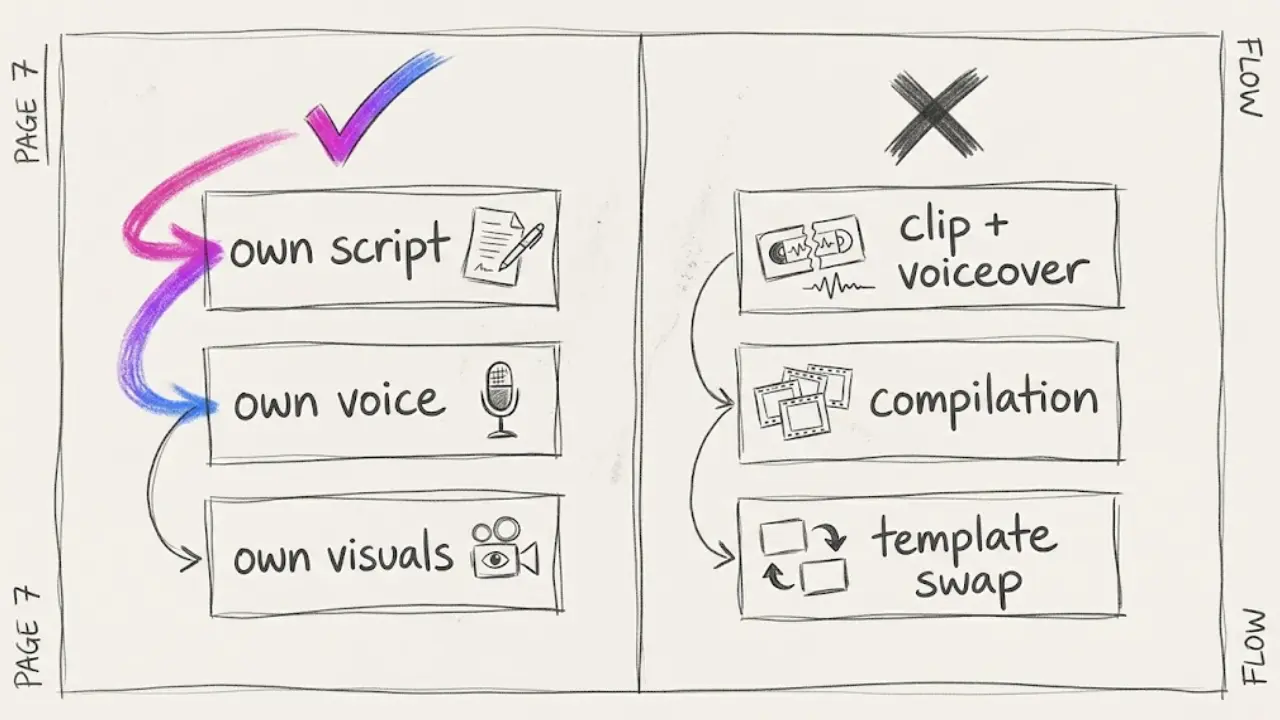
Here is a practical way to sort your own videos.
Reads as original:
- A script you wrote about an idea, a story, a list or a question.
- A video where the voice, the visuals and the structure were all made for this video.
- A clip with real commentary, a clear opinion or a story that someone else's footage did not already tell.
Reads as a re-upload:
- Someone else's Short with a new caption or a song swapped in.
- A compilation of other creators' clips with a thin voiceover.
- A batch of videos run through the same template where only the source clip changes.
If you want to share a video you did not make, Ritchie's suggestion was the Posts tab, which sends viewers to the original upload.
3. Why a script-first faceless channel sits on the right side
A faceless channel and a re-upload channel can look similar from far away, because neither has a person on camera. The difference is where the video comes from.
A script-first channel starts with your idea. You write or edit the script, pick the voice, and generate visuals that fit it. Nothing in the video was taken from another creator, which is what YouTube says it wants more of.
Three habits keep a faceless channel clearly on that side:
- Start from a script or topic of your own. Not from a clip you found.
- Generate or license your visuals. Do not lift footage from other creators.
- Add a point of view. A fact, a ranking, a story or an opinion that is yours.
One honest note. Being faceless does not make a channel original by itself, and we cannot promise how YouTube will classify any channel. What we can say is that a workflow built around your own scripts is the right foundation.
4. How to make original faceless Shorts inside Faceless Lab
This is the flow we use when we want a video that is clearly ours from the first line.
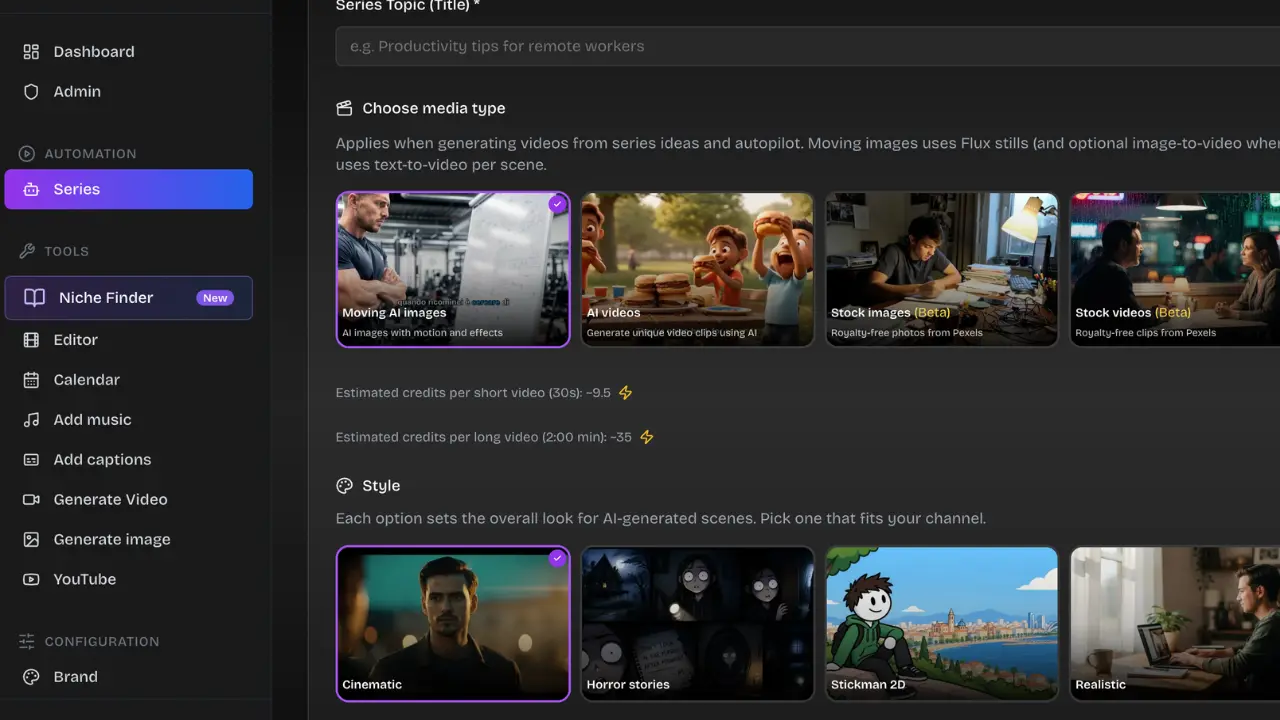
- Start from your own topic or script. Type an idea, or paste a script you wrote. If you generate a draft, edit it until it says what you actually think.
- Pick one of the 8 video structures. Story, list, question and other structures give the video a shape, so it feels designed instead of stitched together.
- Choose a voice. There are 200+ ElevenLabs voices. Pick one and keep it, so your channel has a recognizable sound.
- Lock a visual style. With 39 styles and multiple image models through Replicate, you generate visuals for this specific script instead of reusing someone else's footage.
- Let it assemble. Faceless Lab builds the voiceover, visuals, background music and captions into a finished video.
- Review, edit and schedule. Check the facts, change anything that feels generic, then schedule it. Auto-publish works for connected platforms, with one exception: TikTok is excluded from fully automatic auto-publish and needs your explicit consent.
If you want a repeating format, Series keeps the same look and structure across videos. Autopilot, which is still in beta, goes further toward hands-off.
💡 Want to see how fast the flow is? Create a free account and make your first original faceless video.
5. Give every video an angle that is clearly yours
Generating a video is the easy part now. The part that protects you, and the part viewers actually remember, is the angle.
Ways to make a faceless video unmistakably yours:
- Take a position. "Three reasons this popular tip fails" beats "tips about this topic."
- Use a specific example. One concrete story or number checked against a source does more than ten general claims.
- Keep a recurring format. A named series with the same structure each time builds a brand that a reposter cannot copy.
- Edit the script by hand. Even two minutes of rewriting a line to sound like you changes the result.
- Choose a niche you can talk about for a year. Channels built on a subject you care about stay original without effort.
This is also how you avoid the trap the update is aimed at. A channel that finds a viral clip and adds a voiceover is easy to copy and easy to demote. A channel with its own scripts and its own series is hard to copy.
6. Where Faceless Lab is and isn't the right choice
We built Faceless Lab to remove the production work. It does not remove the need for ideas.
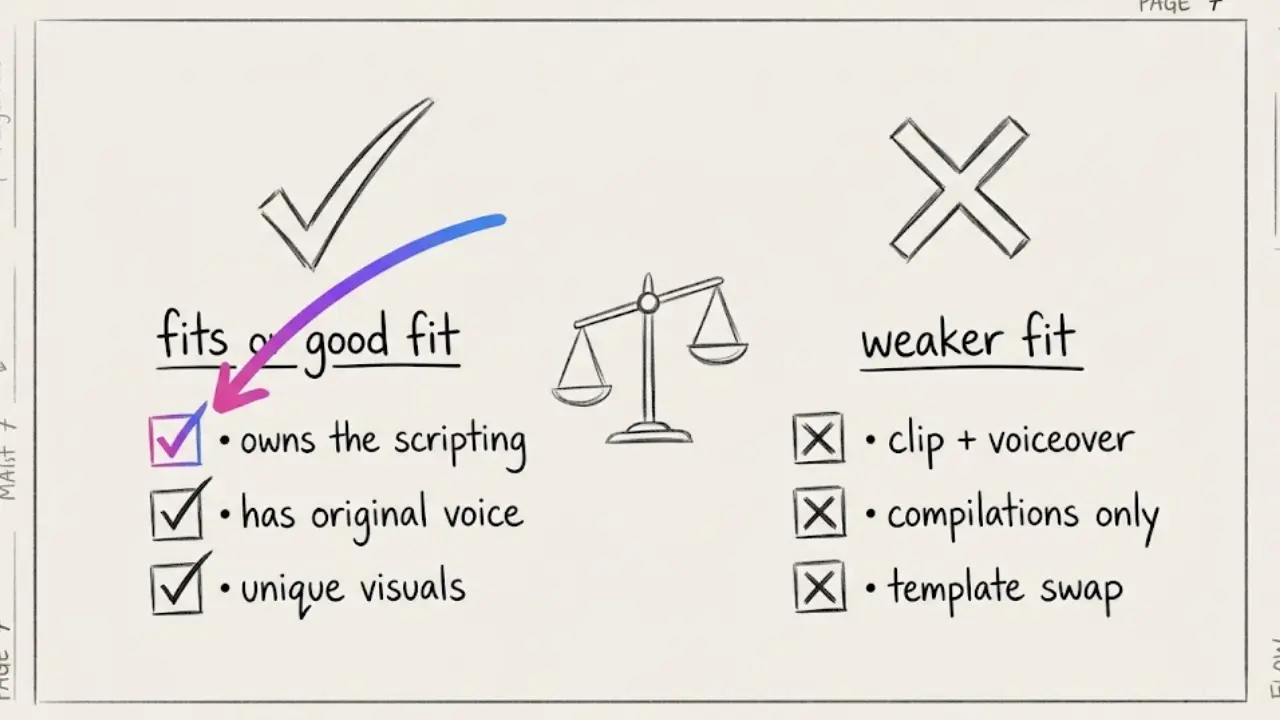
Faceless Lab is a good fit when:
- You want to turn your own topics and scripts into finished videos quickly.
- You post on a schedule and want voiceover, visuals, music and captions handled in one place.
- You plan to publish across several platforms and want scheduling built in.
It is the wrong choice when:
- Your plan is to re-upload other creators' Shorts. The app makes new videos from topics and scripts, and that kind of channel is the one YouTube is targeting.
- You expect the tool to decide what is original for you. Judgment about facts, angle and tone stays with you.
- You want a guarantee about reach. Nobody can give one, and we will not pretend to.
Plans are Free trial at €0, Starter at €19, Growth at €59 and Pro at €149. Start with the free trial and see whether the workflow fits.
7. What to do after the news cycle ends
Platform news fades fast, and the principle behind this one will not. These steps stay useful long after October.
- Audit your last 20 videos. Mark each as original, mixed or re-upload. Stop making the third kind.
- Turn your best original idea into a series. Repeating formats are easier to produce and easier for viewers to recognize.
- Watch your own numbers. YouTube gave no status indicator, so your analytics are the only signal. If reach drops on a channel that leans on borrowed clips, change the model instead of waiting.
- Keep batching. Original work is easier to sustain when you produce a week or a month at a time.
The YouTube Shorts original content update rewards the creators who were already doing the harder, more useful thing. If your faceless channel starts from your own scripts, you are on the right side of it. Try one video this week, add one detail that only you would include, and see how it feels. If a video does well, repost it on your other platforms with your own caption, and tell a friend who is stuck on the editing step. If you enjoy Faceless Lab, our affiliate program is an easy way to earn while you share it.
Try Faceless Lab free and make your first original faceless video today.
Read more
Frequently asked questions
What did YouTube announce about Shorts and original content?
On October 1, 2026, YouTube said in a TeamYouTube community post that it will further prioritize original content on Shorts and reduce the reach of content re-uploaded from other creators. Channels identified as primarily aggregating or re-uploading other creators' videos without significant changes will likely see less distribution. YouTube gave no start date, no ratio and no definition of significant. The announcement is about recommendations and does not mention monetization, so treat any more specific claim as speculation until YouTube publishes more detail.
Are faceless channels affected by the YouTube Shorts original content update?
Being faceless is not the issue. The update targets channels that mainly re-upload or aggregate other creators' videos. A faceless channel that writes its own scripts, generates its own voiceover and creates its own visuals is making new work, which is what YouTube says it wants to recommend more. A faceless channel built on other people's clips with a voiceover on top sits on the risky side. No tool or channel type can guarantee how YouTube will classify it, so keep adding your own angle.
Does adding a voiceover make a reposted Short original?
According to Search Engine Journal's report of the Creator Insider video, YouTube's Creator Liaison said voice-over that only describes what is happening on screen, minor technical edits and template-based bulk changes do not make another creator's clip original. The safer approach is to start from your own script, then add your own explanation, perspective or story. If you want to share someone else's video, YouTube suggested the Posts tab, which sends viewers to the original upload instead of copying it.
Will this change affect my YouTube monetization?
The October 1 announcement itself does not mention monetization. YouTube's existing reused content rules already say that if you borrow content from someone else, you need to change it significantly to make it your own. Separately, new Partner Program applicants from February 1, 2027 need 8,000 watch hours or 20 million qualified Shorts views, and Shorts creator pool eligibility keys off 10 million qualified views in a rolling 90 days. Original videos make those numbers easier to reach.
How do I make original faceless Shorts with Faceless Lab?
Start from your own topic or a script you wrote. Pick one of the 8 video structures, choose from 200+ ElevenLabs voices, and lock one of the 39 visual styles. Faceless Lab then builds the voiceover, visuals, background music and captions into a finished video, which you review, edit and schedule. Series keeps the format consistent across videos, and Autopilot is in beta if you want a more hands-off setup. Plans are Free trial at €0, Starter at €19, Growth at €59 and Pro at €149.
What should I do if my Shorts reach drops after this update?
YouTube did not provide a status indicator, so start with your own analytics. Compare the last 20 videos and mark each as original, mixed or re-upload. If reach fell mostly on videos built from borrowed clips, change the model and move to scripts of your own. Keep a recurring format, add a clear point of view to every video, and batch your production so quality stays steady. YouTube said its recommendation system will re-evaluate reach for channels that move from aggregating toward original work, though it gave no timescale.
Related articles
Make Faceless Diwali Videos for the Festival of Lights, Starting This Week
Diwali peaks on November 8. Here is how to make respectful faceless Diwali videos with AI, which formats get watched, and how to schedule all five days without ever filming.
Ride the Final Stretch of the F1 Season With a Faceless Racing Channel
The F1 season runs until the Abu Dhabi finale on December 6. A faceless racing channel batched now can post breakdowns, rankings and title-fight stories with no camera and no race footage.
Start a Faceless Hockey Channel While the NHL Season Is Still Fresh
The 2026-27 NHL season opened September 29. A faceless hockey channel batched now can post breakdowns, rankings and storylines from the Winter Classic to the playoffs, with no camera and no game footage.