YouTube Just Turned Shorts Into Shows. Here Is How to Make a Faceless One
YouTube now lets creators group Shorts into seasons and episodes. Here is how faceless creators can plan a season, script cliffhangers and ship every episode on schedule.
Roberto Pasqualini
CMO at Faceless Lab
What YouTube's new Shorts series feature is, why episodic stories suit faceless channels, five series formats to try, and how to plan and schedule a full season without filming.
What is YouTube Shorts series, and how do you make a faceless one? On September 23, at Made on YouTube in New York, YouTube announced a tool that lets creators organize their Shorts into seasons and episodes, with custom thumbnails and playback in order. For faceless creators this is a big deal. We are Stefano and Roberto, the co-founders of Faceless Lab, and we have been building faceless series for months. Here is how we would use the new feature starting this week.
Executive Summary
YouTube Shorts series, announced on September 23, 2026, lets creators group Shorts into seasons and episodes that viewers can watch in order from a show feed, with custom thumbnails. YouTube says microdramas passed 6.5 billion views on the platform in the first half of 2026, which is why it is betting on episodic Shorts. Faceless channels are well placed to benefit because a narrated story told with AI visuals, one consistent voice and a fixed structure is easy to split into episodes. The winning approach is to plan a full season before episode one, end each episode on an open question, keep the look and voice identical, and publish on a fixed rhythm. In Faceless Lab you can build a season as a Series, generate each episode with script, voice, visuals, captions and music, and schedule it to publish automatically.
Table of Contents
- What YouTube Shorts series is and why it matters now
- Why episodic stories suit faceless channels
- Five faceless series formats built for seasons and episodes
- Plan a season before you make episode one
- How to build a Shorts series inside Faceless Lab
- Where Faceless Lab is (and is not) the right choice
- Conclusion
1. What YouTube Shorts series is and why it matters now
Until now, finding episode one of a Shorts story was a chore. You would stumble on part 8 in the feed, open the channel, and scroll backwards hoping the creator had numbered things properly. Most people gave up before they found the start.
What YouTube announced
- Seasons and episodes for Shorts. Creators can group Shorts into a series and structure it in seasons.
- Custom thumbnails and sequential playback. Viewers who land on any episode can open the show and keep watching in order.
- Lives on your channel. The series sits on your channel page, much like the Creator Shows feature YouTube already offered for long-form.
- Web, mobile and TV. YouTube says the feature started rolling out to creators on September 23. TechCrunch reports that it is going to creators in the YouTube Partner Program first, so check YouTube Studio to see when it reaches your channel.
The numbers behind the bet
YouTube did not build this on a hunch. According to its own announcement, microdramas on YouTube passed 6.5 billion views in the first half of 2026, with watch time up more than 50% year over year. Microdrama views on TV screens grew more than 90% in the same period. Kurt Wilms, who leads product for YouTube on TV, also told TheWrap that viewers watch 2 billion hours of Shorts on TV screens every month.
Put simply, people are already watching short stories in order, and YouTube just gave them a proper way to do it.
Why moving early helps
Every new format has a short window where few creators use it well. The first channels with clean, bingeable series will be the examples viewers get used to. A small faceless channel can be one of them. What it takes is a story worth continuing and the discipline to publish the next part on time.
2. Why episodic stories suit faceless channels
When people hear "microdrama" they picture actors, sets and a production crew. That is one version. The faceless version is a narrated story told through AI visuals, and it has some real advantages.
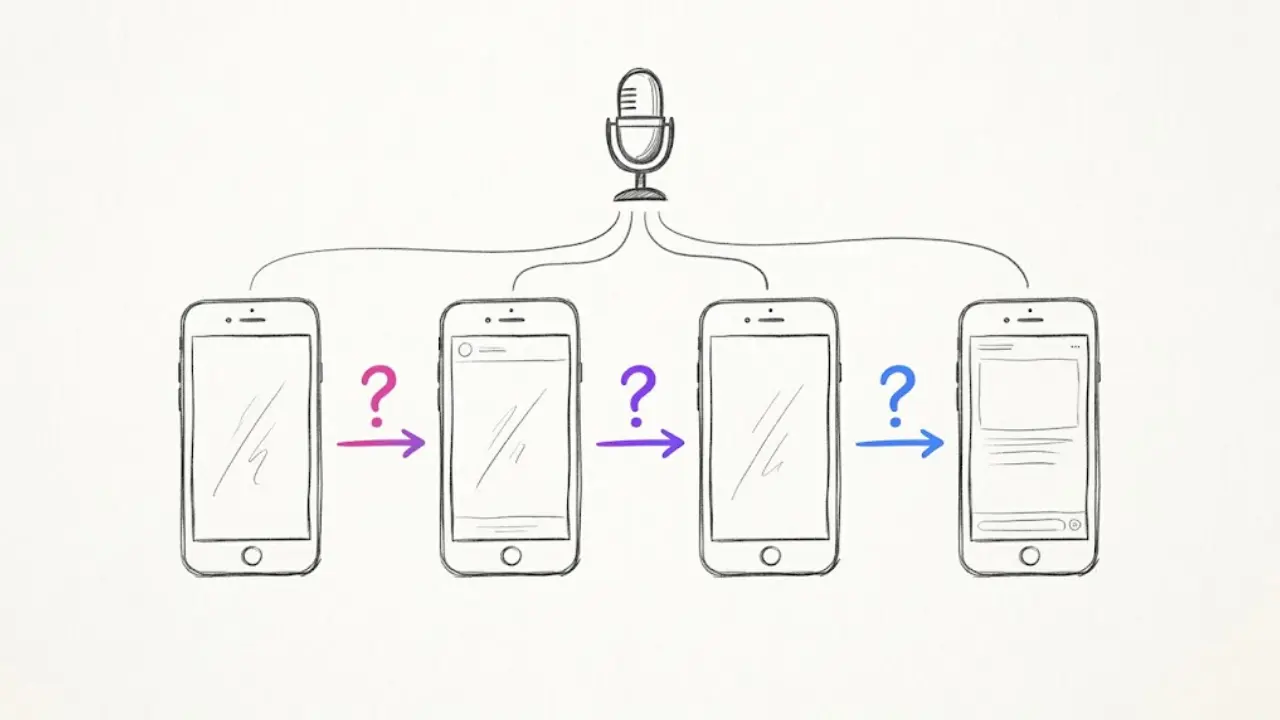
The narrator is the constant
In a faceless series, the voice does the job an actor does in a live-action show. If every episode uses the same narrator, viewers recognize your show within a second, even when they meet it halfway through a season. That consistency is easy with an AI voice and very hard with a rotating cast.
Cliffhangers do the growth work
A standalone Short has to win the viewer once. A series episode has a second job: make people want the next one. When the ending leaves a question open, viewers tap through to the show feed, and each view feeds the next episode. That chain is the whole point of the feature.
Faceless production scales to a season
A live microdrama season means scheduling people and locations. A faceless season means writing ten scripts and generating ten videos with the same style. You can batch a full season in an afternoon, which is exactly how we like to work.
It fixes the "what do I post tomorrow" problem
Once a season is planned, you already know tomorrow's video. That removes the daily blank page, which in our experience is the main reason faceless channels go quiet.
3. Five faceless series formats built for seasons and episodes
Not every niche needs a series. These five formats split naturally into parts and work without a face on screen.
1. The narrated micro-drama
A fictional story told by a narrator over AI scenes: a family secret, a workplace rivalry, a relationship twist. Each episode covers one beat and ends on a reveal. Keep characters few and names memorable so people can follow along out of order.
- Episode length: 45 to 60 seconds
- Season size: 8 to 12 episodes
- Best structure: story-style with a hook and a cliffhanger ending
2. The mystery in parts
Unsolved cases, strange disappearances, historical mysteries. Part one sets the scene, the middle episodes add clues, the finale covers the theories. This format rewards people who watch in order, which is exactly what the show feed makes easy.
3. History as a mini season
One empire, one war, one famous shipwreck, told across six or eight episodes. History channels already do "part 1, part 2" posts. Shorts series simply makes those parts findable.
4. The explainer course
"Investing basics in 7 episodes" or "How the human brain works in 10 parts." Each episode teaches one idea and teases the next. This is great for educational channels because the series itself becomes a free mini course.
5. The recurring countdown
A season of rankings on one theme: the 10 strangest deep-sea creatures, one per episode, counting down to number one. The final episode gets a natural boost because everyone wants to know what ranked first.
A quick note on originality
A series is still subject to YouTube's rules on inauthentic, repetitive content. Ten episodes that differ only in one swapped word will not look like a show. Give each episode its own beat, its own reveal and its own reason to exist.
4. Plan a season before you make episode one
The biggest mistake we see is starting a series with one good idea and no plan. Episode three arrives, the story runs out, and the channel stalls. Ten minutes of planning saves the whole season.
Write the season on one page
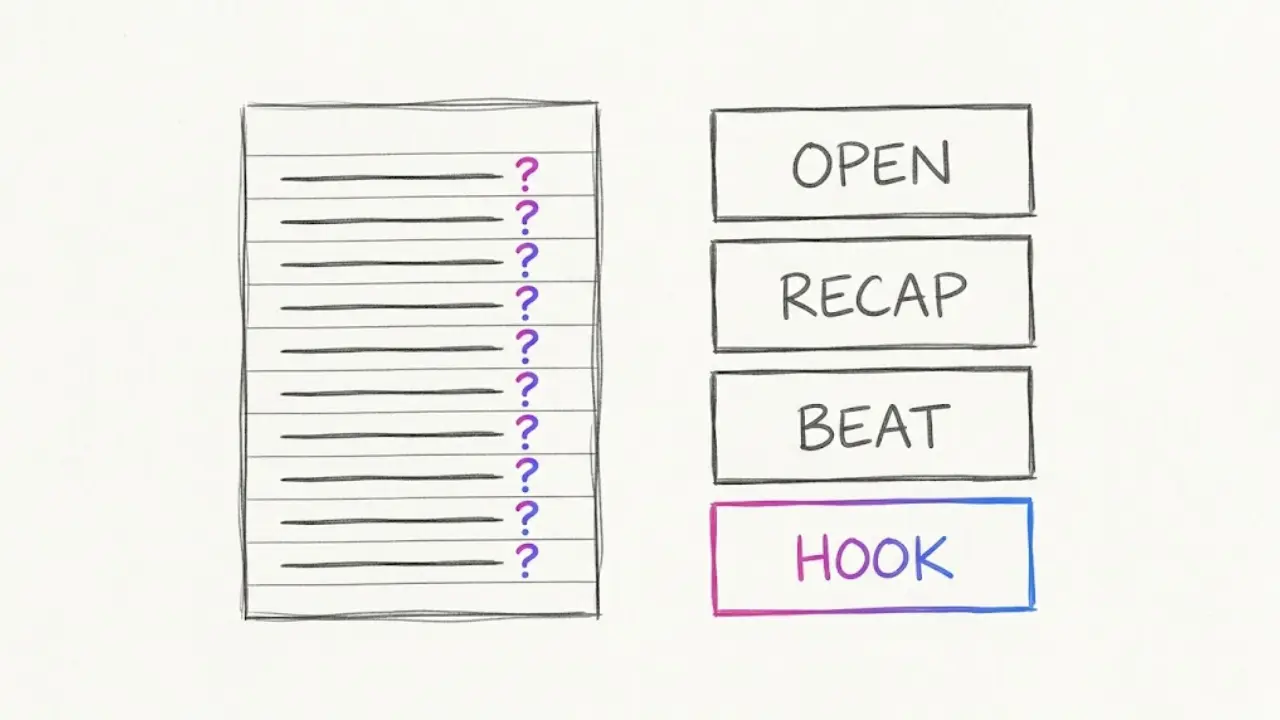
Before generating anything, list every episode with one line each:
- Episode title (short and numbered, like "The Lighthouse, Ep. 3")
- What happens in one sentence
- The open question it ends on
If you cannot fill ten lines, make it a six-episode season. A tight short season beats a long one that fizzles.
Build every episode on the same skeleton
- Cold open (first 2 seconds): a line that works even for someone who has never seen the show. "She found the letter in the wall on the third night."
- Quick recap (one line): only from episode two onward. "Last time, the keeper vanished."
- The beat: the one thing that happens in this episode.
- The hook out: end on a question, never on a conclusion. "So who had been writing back?"
Pick a rhythm you can keep for the whole season
Viewers who binge a show come back for the next part. Posting daily is ideal while a season is live, but three episodes a week on fixed days also works if that is what you can sustain. What kills a series is a two-week gap in the middle.
Design the series cover once
Your series thumbnail and episode thumbnails should share a look: same colors, same font, same framing, with the episode number clearly visible. People scanning a show feed decide in a glance, and a consistent cover tells them this is one story.
5. How to build a Shorts series inside Faceless Lab
Here is the workflow we use to go from a one-page season plan to a scheduled run of episodes.
Step 1: Create a Series for the season
In Faceless Lab, a Series keeps your settings locked across episodes: the same structure, voice and visual style. Name it after your show so every episode inherits the same identity.
Step 2: Choose the structure
Pick one of the 8 video structures. A story-style structure suits microdramas and mysteries, a countdown suits ranking seasons, and an explainer structure suits mini courses. Keep the same one for the whole season.
Step 3: Paste or generate each episode script
You can type the episode's one-line summary and let the AI draft it, or paste a script you wrote yourself. Either way, read it before generating. Check that the cold open works for a new viewer and that the ending leaves a real question.
Step 4: Lock one narrator
Choose a voice from more than 200 ElevenLabs voices and never change it mid-season. A calm, low voice fits mystery and history, a warmer voice fits drama and relationships.
Step 5: Lock one visual style
Choose one of the 39 visual styles. Faceless Lab also lets you pick between several AI image models through Replicate, which helps when one model is better at faces in shadow, landscapes or period costumes. Keeping the characters looking consistent across episodes matters a lot in a series, so test a couple of scenes before batching.
Step 6: Captions and music
Captions are generated automatically and you can edit them. Pick one background track mood for the whole season from the music library, where copyright-free tracks are clearly marked.
Step 7: Schedule the season
Schedule episodes to publish automatically on YouTube, Instagram, Facebook and LinkedIn, one per day or on the days you chose. TikTok publishing needs your explicit consent on each post, so it is not fully hands-off there. If you want to keep a Series going beyond the planned season, Autopilot (currently in beta) can keep generating on the rhythm you set.
Step 8: Group the episodes in YouTube Studio
Once the episodes are live and Shorts series has reached your channel, group them into the series in YouTube Studio and add your series thumbnail. We do this in one sitting after the first few episodes go up.
💡 Want to try it on your first season? Create your free Faceless Lab account and generate episode one today.
6. Where Faceless Lab is (and is not) the right choice
We would rather you pick the right tool than the wrong one, so here is our honest view.
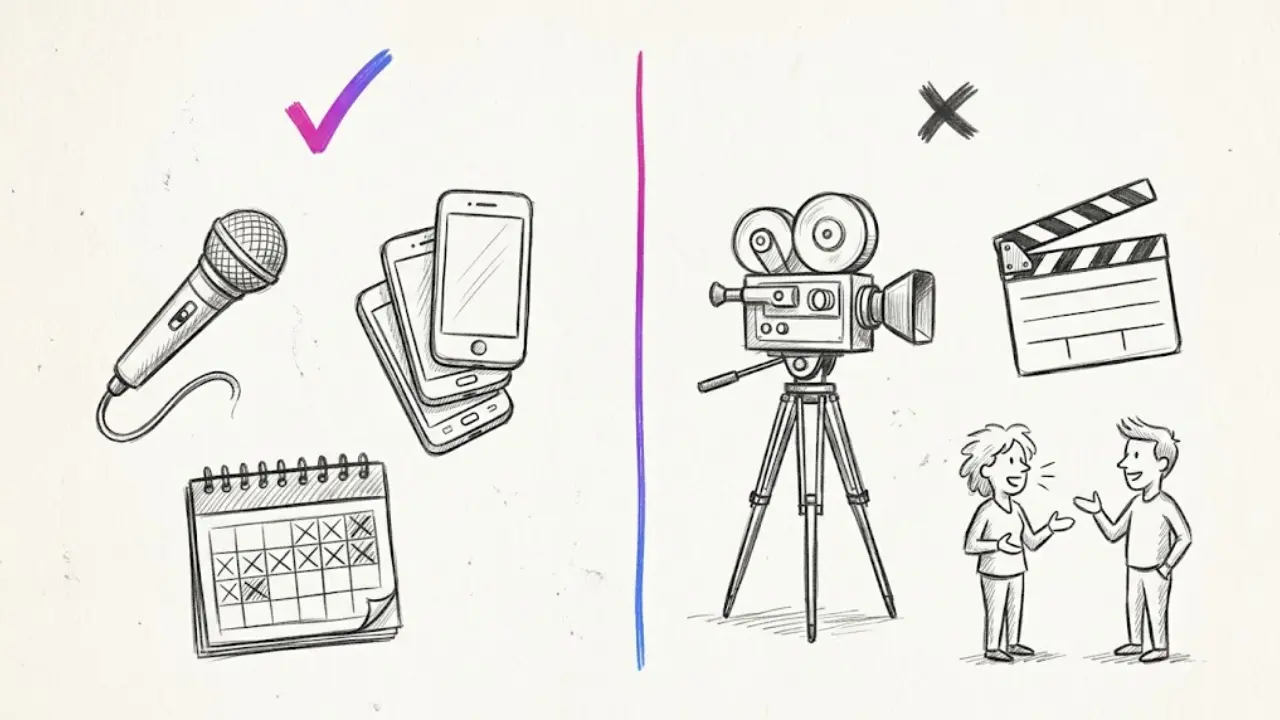
Faceless Lab is a good fit if
- You want to publish a full season of narrated episodes without editing each one by hand.
- You need the same voice, style and structure locked across every episode.
- You want creation, scheduling and auto-publishing in one place.
- You want to start free and pay only when the channel works. Plans are Free trial €0, Starter €19, Growth €59 and Pro €149 per month.
It is probably not the right choice if
- You want a live-action microdrama with actors. That is a film production job. Faceless Lab makes narrated videos with AI visuals.
- You need lip-synced dialogue between characters. Our series are narrator-led. If your show depends on characters speaking on camera, you need a different pipeline.
- You want frame-by-frame editing control. A traditional editor gives you more manual precision on every cut.
- You plan long episodes. We focus on short-form and support videos up to 5 minutes. Longer episodes belong in a long-form workflow.
7. Conclusion
YouTube Shorts series turns a scattered pile of "part 1, part 2" uploads into a real show that viewers can find and binge. The platform is clearly betting on episodic short-form, and the early data on microdramas backs that up. Faceless creators are in a good spot because a narrator, a locked visual style and a planned season are all things you control completely.
Our verdict: if you already run a faceless channel, turn your next idea into a six to ten episode season this week. Plan it on one page, end every episode on a question, keep the voice and look identical, and publish on a rhythm you can hold until the finale.
You can build and schedule your first season on the free trial and see how it performs before paying anything. If this guide helped, repost it for a friend who keeps saying "part 2 coming soon," and if you already love Faceless Lab, ask us about our affiliate program.
Try Faceless Lab free and build your first Shorts series
Read more
Frequently asked questions
What is YouTube Shorts series?
Shorts series is a YouTube feature announced at Made on YouTube on September 23, 2026. It lets creators group their Shorts into seasons and episodes, add custom thumbnails, and give viewers sequential playback, so someone who finds one episode can open the show and watch the rest in order. The series lives on the creator's channel and works across web, mobile and TV. It builds on Creator Shows, a similar tool YouTube already offered for organizing long-form videos into seasons. YouTube says it created the feature partly because microdramas are growing quickly on the platform.
Who can use YouTube Shorts series?
YouTube said Shorts series began rolling out to creators on September 23, 2026, across web, mobile and TV. TechCrunch reported that the rollout is aimed at creators in the YouTube Partner Program. In practice, features like this usually reach channels gradually, so it may not appear on your account right away. The simplest way to check is to look in YouTube Studio for the option to create a series. While you wait, you can still plan and publish your episodes, then group them into a series once the feature is live on your channel.
Can a faceless channel make a microdrama series?
Yes. Classic microdramas use actors, but a faceless version works as a narrated story told over AI visuals. One consistent narrator carries the story, a locked visual style keeps characters and settings recognizable, and each episode covers one beat and ends on a cliffhanger. This format suits fiction, mysteries, true stories and history. The main limit is dialogue: if your show depends on characters speaking on camera with lip sync, a narrator-led faceless approach will not replace that. For most story channels, narration works well.
How many episodes should a Shorts season have?
For a first season, six to ten episodes is a good range. It is long enough for a real story arc and short enough that you can plan it on one page and finish it without running out of ideas. Write one line per episode before you start: what happens and what question it ends on. If you cannot fill ten lines, go with six. Viewers forgive a short season much more easily than one that stops halfway or loses quality near the end. You can always add a second season if the first one performs.
How long should each episode in a Shorts series be?
Most story episodes work best between 45 and 60 seconds. That leaves room for a cold open, a one-line recap, one clear story beat and a cliffhanger at the end. Explainer or countdown series can be shorter, around 30 to 45 seconds per episode, because each part covers a single idea. Watch your retention data after the first few episodes: if people drop off before the ending, cut words rather than adding scenes. Faceless Lab focuses on short-form and supports videos up to 5 minutes if a format needs more time.
Does Faceless Lab add my videos to a YouTube Shorts series automatically?
Faceless Lab handles the production and publishing side. You can build a whole season as a Series with the same structure, voice and visual style, generate each episode with script, voiceover, AI visuals, captions and music, and schedule it to publish automatically on YouTube, Instagram, Facebook and LinkedIn. Grouping the published Shorts into a YouTube Shorts series and adding the series thumbnail is done inside YouTube Studio. You can start on the Free trial at €0, with paid plans at €19, €59 and €149 per month.
Related articles
Animal Facts Are the Faceless Niche People Send to Their Friends
Animal facts are one of the easiest faceless niches to start and one of the most shared. Here is how to pick a sub-niche, script shorts that hold, keep every fact accurate, and post daily.
Post Your Faceless Videos When Your Audience Is Actually Watching
The best times to post faceless videos on YouTube Shorts, TikTok and Instagram Reels, why the first hour decides your reach, and how to automate it so you never watch the clock.
Make Faceless ASMR Videos Without Recording a Single Sound
Sleep and relaxation content is one of the few niches that stays calm and keeps paying. Here is how to build a faceless ASMR channel with AI voice, visuals and music, no camera and no mic needed.