Tell Stories on Shorts and Reels Without Ever Showing Your Face
Storytelling is the format that makes faceless videos feel human. Pick a story type, build a hook and a turn, add an AI voice and visuals, then schedule a whole series.

Stefano Ventrudo
CTO at Faceless Lab
A practical guide to making faceless storytelling videos with AI, from choosing a story type to writing the hook, keeping one look and scheduling a full series.
Wondering how to make faceless storytelling videos that people actually watch to the end, with no camera and no on-screen host? Short stories are one of the few formats where the voice and the pictures do all the work, so your face adds nothing the viewer is missing. We run faceless channels ourselves, and the stories that perform best all share the same bones: a sharp first line, a clear turn and an ending that makes someone press replay.
Faceless storytelling videos are short narrated stories, usually 30 to 90 seconds long, told with an AI voiceover, AI visuals, captions and music instead of a person on camera. The stories that hold viewers have a hook in the first three seconds, one main character or situation, a turn in the middle and a final beat that lands. You can tell original fiction, retold folktales, true-feeling anecdotes or listener stories. Choose one story type, lock one visual style and one voice, write each script around a single twist, batch several episodes in one sitting and schedule them so the channel keeps posting.
Table of Contents
- Why storytelling suits faceless video
- The story types that work without a face
- How to make a faceless storytelling video inside Faceless Lab
- Write a story that holds attention for 60 seconds
- Turn single stories into a series
- Where faceless storytelling is and isn't the right choice
- Stay original and keep your channel safe
1. Why storytelling suits faceless video
A talking head sells personality. A story sells curiosity, and curiosity does not need a host. When someone hears "I found a door in my basement that was not there yesterday," they stay for the answer, whoever is reading it.
Three things make the format a good fit for a faceless channel:
- The voice carries the emotion. A good AI voice with the right pacing can whisper, slow down before a reveal and speed up in a chase. That is most of what a human narrator does.
- The visuals only need to support the words. Moody scenes, silhouettes, objects and landscapes are enough. You never have to show a character's face, which also avoids the uncanny look that AI faces can have.
- Stories repeat. A format you can run again with a new plot is a format you can post every day. Genres, settings and twists give you hundreds of combinations.
Storytelling is also the skeleton under many niches we already cover. If you want a specific genre, start with our guides on faceless Reddit story videos, faceless horror story videos or fake text story videos. This guide covers the craft they all share.
2. The story types that work without a face
Choose one type for your first ten videos. A channel that tells one kind of story is easier to recognize and easier to subscribe to.
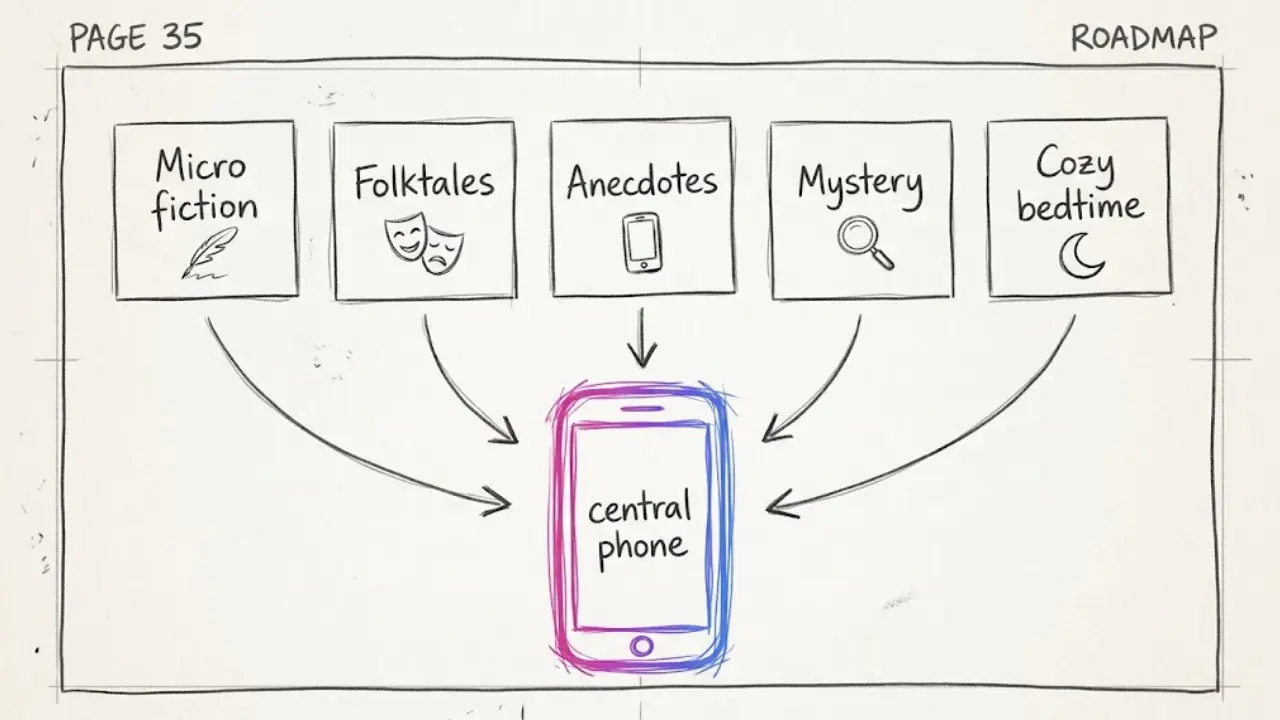
Original micro fiction
A complete story in under a minute, such as a lighthouse keeper who receives a letter from himself. You own the idea, nobody can claim it and the format suits a recurring series. Keep one character, one setting and one twist.
Retold folktales and legends
Old stories from many cultures are free to retell in your own words. A short version of a fable with a modern angle works well. Our guide to faceless mythology videos shows how to turn ancient material into episodes.
Anecdotes and "this happened" stories
First-person style stories about a strange neighbor, a wrong number or a small act of kindness. Present them as stories. Do not claim they are real if you invented them.
Mystery and suspense
A short case, a locked room or an unexplained sound, told in a calm voice. Suspense rewards patient pacing and a hook that opens a question. If you lean toward real cases, read our guide to faceless true crime videos first, because those carry extra responsibility.
Bedtime and cozy stories
Slow, gentle stories with a soothing voice and soft visuals. They work for adult audiences who want to wind down. If you aim at children, check each platform's rules for content made for kids before you publish.
3. How to make a faceless storytelling video inside Faceless Lab
This is the loop we use, from a one-line idea to a scheduled post.
- Start from an idea or a script. Type a premise like "a lighthouse keeper receives a letter from himself" or paste a story you already wrote. Faceless Lab turns it into a short with scenes. You can choose from 8 video structures, so a twist story and a countdown list are laid out differently.
- Choose a visual style. There are 39 styles, powered by multiple models through Replicate. For stories, pick a cohesive look that matches the mood, such as painterly and dark for suspense or soft and warm for a cozy tale. Keep it for the whole series.
- Pick a voice. You get 200+ ElevenLabs voices. A calm, low voice suits mystery, while a warmer one suits a fable. Use the same voice every episode so the channel has a recognizable narrator.
- Let it build the video. Faceless Lab generates the voiceover, matches visuals to each line, adds captions and drops in background music. You get a publish-ready vertical video in minutes.
- Review the pacing. Read the captions and listen to the first three seconds. Swap an image that does not match the line, shorten a sentence that drags, and check that the last beat lands.
- Schedule and publish. Connect your accounts and Faceless Lab can publish to YouTube, Instagram, Facebook and LinkedIn for you. TikTok needs your explicit consent, so it is left out of fully automatic publishing.
That takes a story from a single sentence to a scheduled post without opening a separate script tool, voice tool, image generator and editor.
💡 Ready to try it on your first story? Create your first video free.
4. Write a story that holds attention for 60 seconds
A short story gives you very little room. Every line has to push forward.
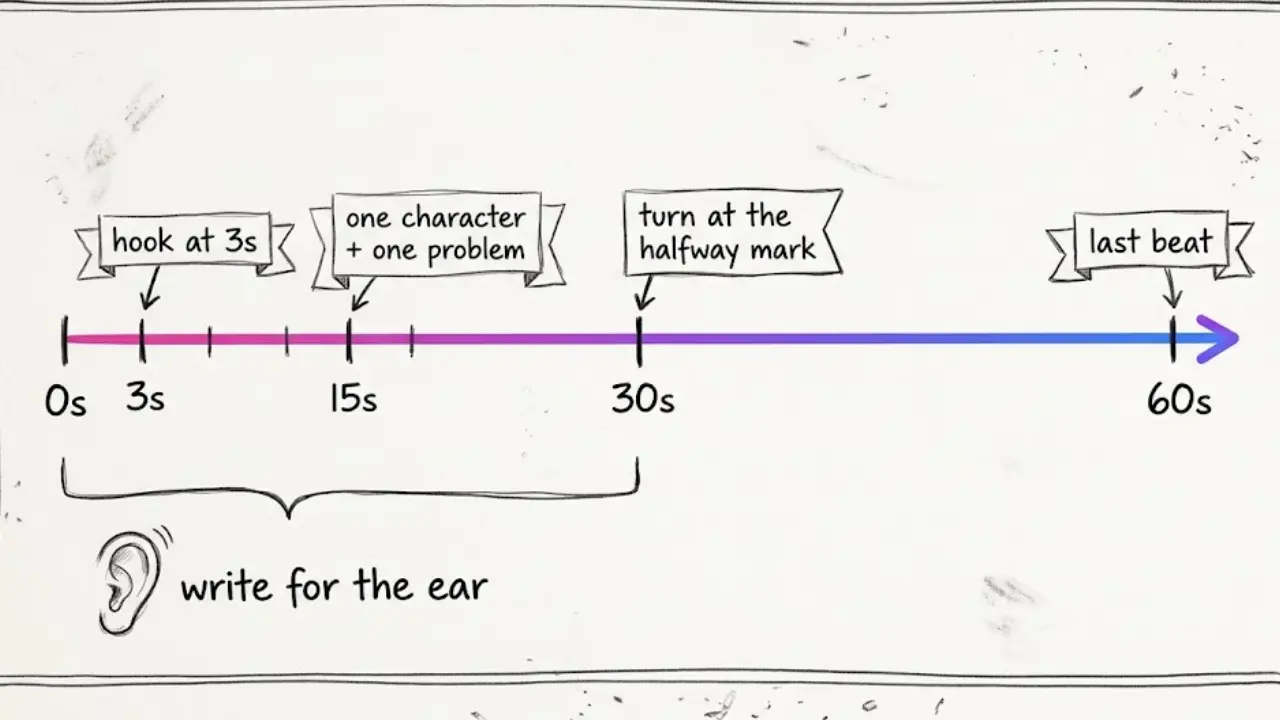
Open in the middle of the moment. "The phone rang at 3 a.m., and it was my own number." Skip the setup. The viewer decides in about three seconds whether to stay, so the first line should raise a question. Our guide to writing faceless video scripts that hook fast goes deeper on openings.
Give the story one character and one problem. A second character is fine when the plot needs one. Beyond that, a 60 second story gets crowded and confusing.
Build to a turn at the halfway mark. Something should change around 25 to 35 seconds in. A reveal, a mistake, a surprise or a decision. Without a turn, a story is just a description.
End on an image or a line, not a summary. The last beat should feel like a door closing. Cut the moral and the recap. Viewers who finish and feel something tend to replay, comment or share.
Write for the ear. Short sentences, concrete words and rhythm. Read the script aloud once. If you run out of breath, the AI voice will too. Our guide to adding a natural AI voiceover shows how to get a read that does not sound robotic.
Match length to the story. Most of our story tests sit between 40 and 75 seconds. Let the plot decide. Our guide on what faceless video length gets watched to the end has more detail.
5. Turn single stories into a series
One story is a video. A recurring format is a channel.
Pick a repeatable promise. "A 60 second mystery every day" or "One retold legend every Friday" tells the viewer what they get when they subscribe.
Use a fixed template. The same opening line style, the same narrator and the same visual style across episodes. Only the plot changes. This is what makes a backlog feel like a show.
Plan arcs when you are ready. Once a format works, link episodes with a recurring character or a running mystery, and end an episode on a question that the next one answers. Start simple, because arcs are harder to keep consistent.
Batch a week at a time. Write five premises, produce five videos and schedule them. With style and voice locked, each new video is mostly a new script.
Use Series to keep it running. Series lets you set up a repeatable format once and keep producing from it. Autopilot is in beta and built to keep a channel posting on a rhythm without starting from zero each day. You still choose the premises and review the stories.
6. Where faceless storytelling is and isn't the right choice
Here is the honest read from the two of us.
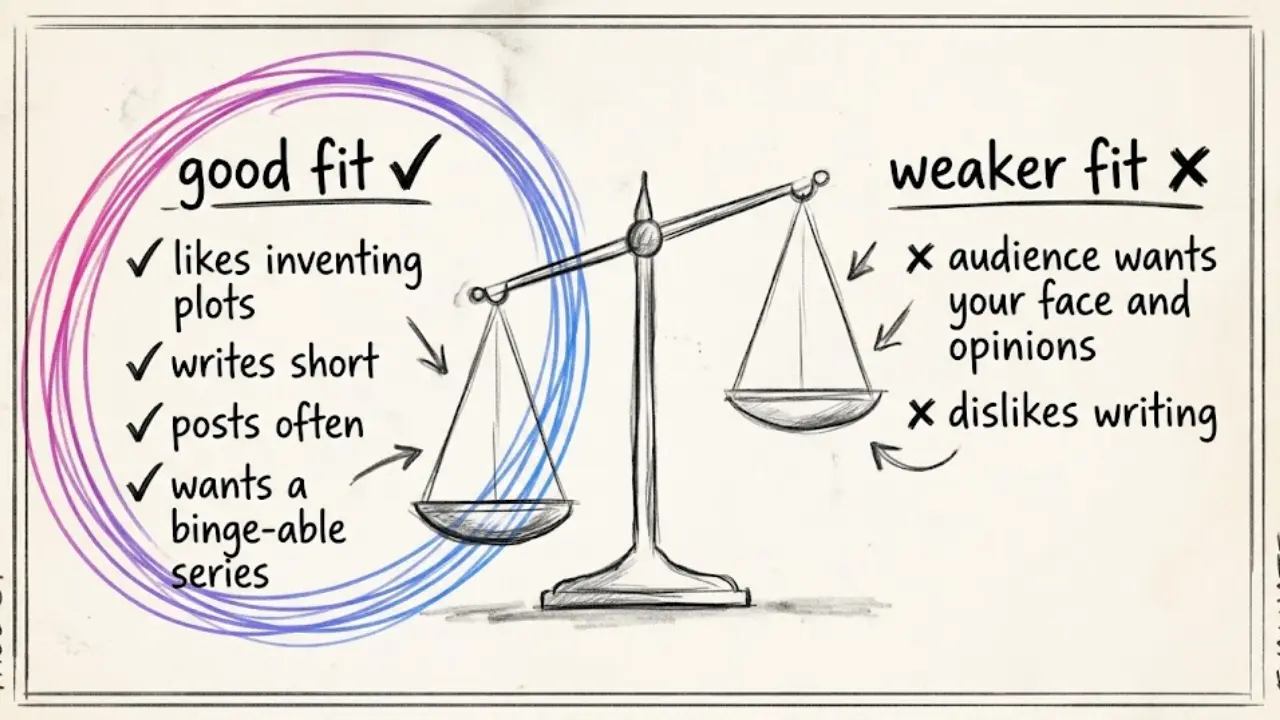
It is a strong choice if you enjoy inventing plots or retelling old ones, you like writing short and you can commit to a daily or near-daily rhythm. It also suits you if you want a channel that can grow into a binge-able series with a loyal audience.
It is a weaker choice if your audience comes for your personality, your opinions or your face. Commentary and reaction channels win on the host, and a narrated story cannot replace that. It is also harder if you hate writing, since the script is the product.
Faceless Lab has limits too. Automatic publishing covers YouTube, Instagram, Facebook and LinkedIn, and TikTok needs your explicit consent. Autopilot is still in beta, so treat it as a strong assistant instead of a machine you can forget. AI visuals can occasionally get small details wrong, such as hands or a prop, so give every story a quick look before it goes out, and keep scenes simple so mistakes show less.
7. Stay original and keep your channel safe
This section protects your channel and your reach, so it is worth a careful read.
Write your own stories. Platforms push back on repetitive, mass-produced content. Bring your own premises and your own voice in the writing, and make each episode different from the last.
Do not copy someone else's story. Retelling a public domain tale in your words is fine. Copying a creator's script, a novel's passage or a movie plot beat for beat is not.
Label fiction as fiction. If a story is invented, do not present it as a real event. Be careful with true crime and real people, and never name or defame a real person.
Mind the sensitive topics. Violence, self-harm and content aimed at children carry extra platform rules. Read the policies of each platform you post on, and keep horror suggestive instead of graphic.
Check how each platform treats AI content. Rules change, and some platforms ask you to label realistic synthetic media. Check the current guidance on each one and follow it.
Stories are the most human thing a faceless channel can make, and a voice plus a clear plot goes a long way. Pick one story type, write your first five premises, lock your look and schedule the run. If one of your videos takes off, repost it on your other accounts and tag it so people can find you, and if you like the tool, our affiliate program pays you to send other creators our way.
Write your first story, start free and let the channel keep telling them: https://facelesslab.video/
Read more
Frequently asked questions
What are faceless storytelling videos?
Faceless storytelling videos are short narrated stories, usually 30 to 90 seconds, told with an AI voiceover, AI visuals, captions and music instead of a person on camera. They can be original fiction, retold folktales, mysteries or cozy bedtime tales. The viewer stays for the plot, so the narrator does not need a face. A tool like Faceless Lab builds the whole video from one premise or script, and you review the pacing and visuals before it publishes.
Can I make storytelling videos with AI and no camera?
Yes. Write or paste a short script, then an AI tool creates the scenes, voiceover, captions and background music. In Faceless Lab you can choose one of 8 video structures, one of 39 visual styles and one of 200+ ElevenLabs voices, then review the vertical video before publishing. Keep scenes simple, because AI visuals can occasionally get small details wrong, such as hands or props, and give each story a quick check before it goes out.
How long should a faceless story video be?
Most short stories work best between 40 and 75 seconds, but the plot should decide. A story needs a hook in the first three seconds, one character or problem, a turn around the middle and a closing beat. If you cannot get there in under 90 seconds, cut a subplot or split the story into two episodes. Shorter stories tend to be easier to finish watching, and a clean ending is what encourages replays and shares.
What kind of stories work best for a faceless channel?
Stories with a strong hook and little dependence on faces do best. Original micro fiction, retold legends, mysteries, anecdote style stories and cozy bedtime tales all work with narration and atmospheric visuals. Pick one type for your first ten videos so viewers know what to expect. If you invent a story, present it as fiction, and read each platform's rules on sensitive topics and content for children before you publish.
How much does it cost to start with Faceless Lab?
You can start on the free trial at €0, which is a good way to test your first story and the workflow before paying anything. The paid plans are Starter at €19, Growth at €59 and Pro at €149, so you move up only when the channel is working and you want more output or automation. You also avoid paying for a separate script tool, voice tool, image generator and editor, because Faceless Lab bundles script, voiceover, visuals, captions, music, scheduling and publishing in one workflow.
Can I publish story videos automatically on a schedule?
Yes. Faceless Lab can schedule and publish to YouTube, Instagram, Facebook and LinkedIn for you. TikTok is excluded from fully automatic publishing and needs your explicit consent. Series lets you set up a repeatable story format once, and Autopilot, which is currently in beta, is built to keep a channel posting on a rhythm. You still choose the premises and review each story, because the quality of the writing is what keeps people subscribed.
Related articles
Share Parenting Tips on Shorts and Reels Without Putting Your Kids on Camera
Parents search for routines and calm-down tricks all year. Learn how to start a faceless parenting channel with AI voice and visuals, keep your family private and schedule tips without filming.
Turn Your DIY Know-How Into Faceless Videos People Save for the Weekend
Start a faceless DIY channel with AI visuals, a clear voiceover and captions. Batch a week of home project how-tos in one afternoon and schedule them to post themselves.
Start a Faceless Car Channel Without Owning a Single Supercar
Cars never stop being searched. Here is how to start a faceless car channel with AI, which formats need no footage, a four-week posting plan and how to keep specs accurate.