Write Faceless Video Scripts That Hook in the First Three Seconds
Most faceless videos die in the first three seconds. Here is how to write a faceless video script that grabs attention fast, holds retention, and turns one idea into a format you can repeat.

Stefano
CTO at Faceless Lab
The script is the one part of a faceless video you fully control, and it is the part that decides whether anyone watches past the first line.
So how do you write a faceless video script that actually holds attention? Most creators pour their energy into visuals and voice, then wonder why the video flops. The truth is simpler. If your first three seconds do not earn the next three, nothing else matters. A great voiceover on a weak hook is a great voiceover nobody hears. In this guide I will walk you through the structure we use on our own channels, the hook formulas, and how to turn any idea into a script in about a minute.
Executive Summary: A faceless video script is not an essay, it is a retention machine. The winning shape is always the same: a hook that stops the scroll in the first three seconds, a middle that keeps paying off small curiosity loops, and an ending that either satisfies or loops back to the start. Platforms rank short video mostly on completion rate and rewatches, so the script exists to protect watch time, not to sound clever. Write for the ear, keep sentences short, open with tension or a promise, and cut every word that does not move the viewer forward. Tools like Faceless Lab can draft this shape for you using eight built-in structures, but the judgment about hook and payoff still comes from you.
Table of Contents
- Why the first three seconds decide everything
- The anatomy of a faceless video script
- Seven hook formulas that still work
- How to write a faceless video script inside Faceless Lab
- Retention tricks that keep people watching to the end
- Where a script generator helps, and where it does not
- Turn one script into a repeatable format
1. Why the first three seconds decide everything
Short-form platforms do not wait around. Within the first few seconds of a video, the algorithm is already reading a signal: did people keep watching, or did they swipe away? That early drop-off is the single biggest reason a faceless video never gets pushed to a wider audience.
The mechanics are brutal but fair. A viewer is mid-scroll, half distracted, thumb ready to flick up. Your opening line has to interrupt that motion before their brain finishes deciding to leave. If it does, you buy three more seconds. Do that four or five times in a row and you have a video that finishes, and a finished video is a video the platform shows to more people.
What this means for your script: the first sentence is not an introduction, it is the whole pitch. You do not get to warm up. No "in this video I will show you," no slow context, no throat-clearing. The value or the tension lands in line one, or it does not land at all.
2. The anatomy of a faceless video script
Every faceless video that performs follows the same three-part spine. Learn it once and you can write to it forever.

The hook (seconds 0 to 3)
This is your promise or your provocation. It tells the viewer, in one breath, why staying is worth it. A hook can be a bold claim, a question they cannot help answering in their head, or a visual and verbal mismatch that makes them curious. Keep it under about 12 words when you can.
The build (the middle)
The middle is where most scripts leak viewers. The fix is to think in curiosity loops: open a small question, answer it, then open the next one before the viewer feels done. Each sentence should either pay off the last beat or set up the next. If a line does neither, cut it.
- One idea per sentence. Long sentences lose the ear.
- Concrete over abstract. "It cost me 400 subscribers" beats "it had consequences."
- Momentum words. "Here is the part nobody tells you," "but then this happened," "watch what changes."
The payoff (the last few seconds)
End on a satisfying answer, a twist, or a loop back to your opening line so the video replays cleanly. Rewatches are pure gold for the algorithm. A weak ending that just trails off tells the platform the video was not worth finishing.
💡 Want the full production side after the script is locked? See our guide on adding a natural AI voiceover so your words do not land in a robotic read. Add a Natural AI Voiceover
3. Seven hook formulas that still work
You do not need to reinvent the hook every time. These seven patterns cover most of what performs. Rotate them so your channel never feels repetitive.
- The bold claim. "This 30-second habit doubled my watch time." Big, specific, slightly hard to believe.
- The direct question. "Why do your videos stop getting views after three seconds?" It forces a silent answer.
- The mistake callout. "You are posting at the wrong time and it is killing your reach." Names a fear.
- The number promise. "Three faceless niches that are quietly printing views right now."
- The story cold open. "I posted the same video twice and one got 10x the views. Here is the only thing I changed."
- The contrarian take. "Consistency is not why small channels grow. This is."
- The stakes reveal. "I almost deleted my channel last month. Then one change fixed everything."
Test line-one out loud. If you would keep scrolling past your own hook, rewrite it. The bar is not "is this good," the bar is "would this stop me."
4. How to write a faceless video script inside Faceless Lab
You can write scripts by hand with the framework above, and sometimes you should. But when you are batching a week of content, drafting from scratch every time is the thing that burns you out. Here is the workflow we actually use.
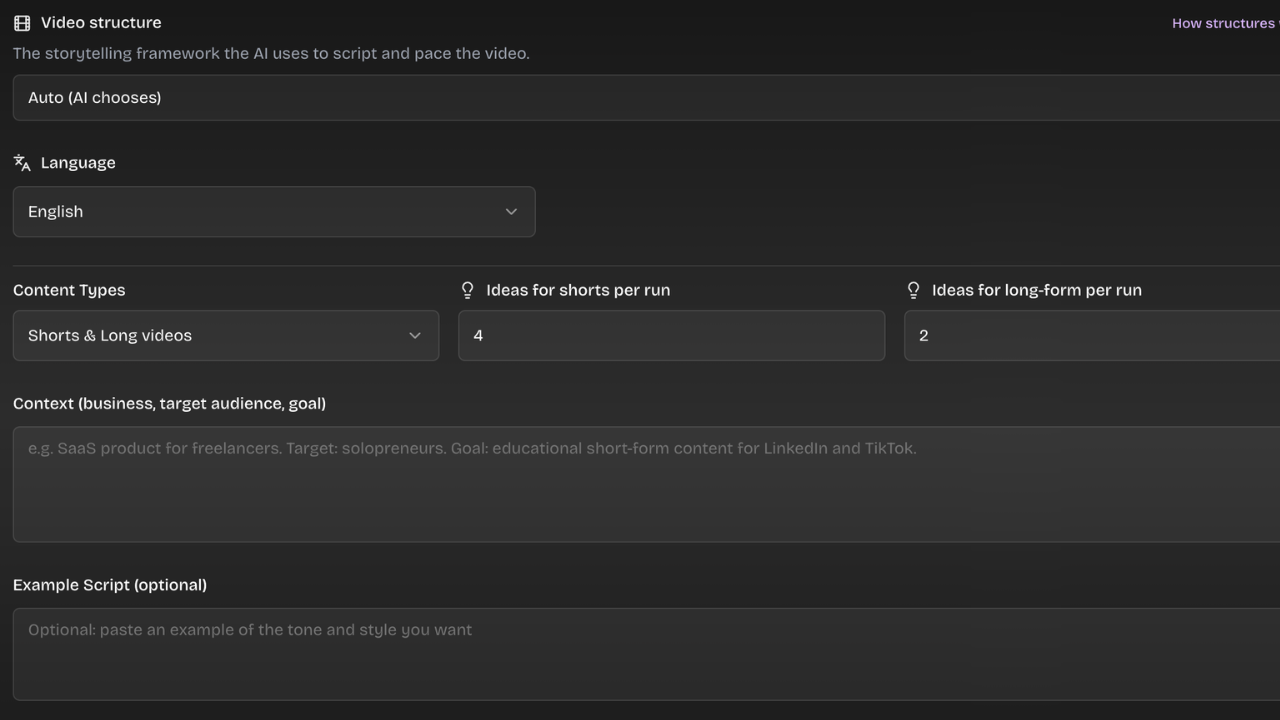
Step 1: Start from an idea, not a blank page. In your Faceless Lab dashboard, open a new video and type your topic or paste a rough idea. One line is enough. The clearer your angle, the sharper the draft.
Step 2: Pick a structure. Faceless Lab ships with eight built-in video structures, so you choose the shape that fits your idea, a story, a listicle, a question-led explainer, and the script is drafted to that skeleton rather than a generic wall of text.
Step 3: Read the hook first, edit it hardest. The AI gives you a full script, but you are the editor. Read line one out loud. If it does not stop the scroll, rewrite it using one of the seven formulas above. This single edit is worth more than any other change you make.
Step 4: Tighten the middle. Cut any sentence that does not open or close a curiosity loop. Shorter is almost always better for the ear.
Step 5: Send it down the pipeline. Once the script reads clean, Faceless Lab turns it into voiceover from a library of 200+ ElevenLabs voices, generates visuals through multiple AI models, adds captions and music, and hands you a publish-ready short. You can then schedule it, or let auto-publish push it out for you.
💡 Ready to try it on your own idea? Start free, no credit card needed: Create your first script
5. Retention tricks that keep people watching to the end
The hook gets them in. These habits keep them there.
- Pattern interrupts. Change the visual, the pacing, or the framing every few seconds so the eye never settles into boredom.
- Caption every word. Most short-form is watched on mute at first. On-screen captions carry the script when the sound is off, and they lift completion rate.
- Cut the intro, cut the outro. No logo sting at the front, no "thanks for watching" at the back. Both are retention leaks.
- Front-load the value. Put the best moment early. Save-the-best-for-last works in film, not in a nine-second short where nobody reaches the last.
- Match voice pace to content. A calm story voice and a punchy list voice are different jobs. The read should serve the script.
💡 Captions are half the retention battle. See how to add subtitles that actually keep people watching. Add Subtitles to Your Faceless Videos
6. Where a script generator helps, and where it does not
I run faceless channels every day, so I will be honest about the trade-offs.

Where an AI script generator earns its place:
- Volume. If you post daily, drafting every script by hand is not sustainable. Getting a solid first draft in seconds is the difference between shipping and stalling.
- Structure. A generator that drafts to a proven skeleton saves you from staring at a blank page and rambling.
- Consistency. It keeps your format steady across a batch, which is exactly what a channel needs to grow.
Where it does not replace you:
- Taste on the hook. AI writes a safe hook. Great hooks are often slightly risky, and that judgment is yours.
- A real point of view. If your channel is built on a specific angle or personality, you have to steer the draft toward it. A generic draft reads generic.
- Fact-checking. Anything stated as fact in your script is your responsibility. Verify before you publish.
The right mental model is co-writer, not ghostwriter. The tool removes the blank page and the busywork. You bring the angle and the final cut. That split is why our workflow is fast without being lazy.
7. Turn one script into a repeatable format
The creators who grow are not writing brand-new formats every day. They find one script shape that works, then run it again and again with fresh topics.
Find your winner. When a video overperforms, do not just celebrate it. Break down why. Which hook formula did you use? How long was the setup? Where was the payoff? That structure is now a template.
Reuse the skeleton, swap the topic. Keep the hook pattern, the pacing, and the ending shape. Change only the subject. A "three things nobody tells you about X" format works for a dozen different X values.
Batch it. Once you have a template, writing ten scripts is faster than writing two from scratch. Draft the batch, schedule the week, and let the videos go out on a rhythm. This is where consistency stops feeling like a grind.
Conclusion
A faceless video script is a retention tool wearing the costume of writing. Nail the first three seconds, keep the middle honest with curiosity loops, and land an ending that satisfies or loops. Do that consistently and the algorithm does the rest. You do not need to be a screenwriter. You need a repeatable shape and the discipline to cut anything that does not earn its place.
If writing scripts is the thing that keeps stalling your posting, let the tool carry the blank page while you keep the judgment. Try Faceless Lab free, draft your first script from a single idea, and see how fast a rough thought becomes a publish-ready short. If a video helps you, repost it and pass it on, and if you love the app, our affiliate program lets you earn by sharing it.
Start here and write your first hook today
Read more
Frequently asked questions
How long should a faceless video script be?
For short-form on TikTok, YouTube Shorts, and Reels, aim for a script that voices in about 20 to 45 seconds, which is roughly 60 to 130 words at a natural pace. Shorter usually retains better because there is less room to lose the viewer. Write the whole idea first, then cut. If a sentence does not open or close a curiosity loop, remove it. For a longer explainer you can stretch toward 60 seconds, but every extra second has to earn its place, since completion rate drops as length grows and unfinished videos get pushed to fewer people.
What makes a good hook for a faceless video?
A good hook stops the scroll in the first three seconds by promising value or creating tension before the viewer decides to leave. The strongest hooks are specific and slightly hard to believe, like a bold claim, a direct question, or a mistake callout that names a fear. Keep it under about 12 words and lead with the most interesting thing, not context. A simple test: read your first line out loud, and if you would keep scrolling past it yourself, rewrite it. The hook is the whole pitch, not an introduction.
Can AI write a faceless video script for me?
Yes, an AI script generator can draft a full faceless video script from a single idea in seconds, which removes the blank page and speeds up batching. Faceless Lab drafts your script to one of eight built-in structures, then turns it into voiceover, visuals, captions, and music automatically. The catch is that AI writes a safe draft, so you still edit the hook, steer the angle, and fact-check anything stated as truth. Think of it as a co-writer that handles volume and structure while you keep taste and the final cut. That split keeps output fast without going generic.
How do I write a script that keeps people watching to the end?
Retention comes from stacking small curiosity loops so the viewer never feels finished. Open a question, answer it, then open the next one before the payoff fully lands. Use one idea per sentence, concrete details over abstractions, and momentum phrases like "here is the part nobody tells you." Cut the intro and outro, front-load your best moment, and end on a twist or a loop back to the opening line so the video replays cleanly. Captions matter too, since most short-form is watched on mute at first and on-screen text carries the script.
Do I need writing experience to make faceless videos?
No. Faceless video scripts follow a repeatable three-part shape: a hook in the first three seconds, a middle built from curiosity loops, and a payoff that satisfies or loops back. You are writing for the ear, not for an essay, so short and clear beats polished and clever. Tools like Faceless Lab draft the structure for you, which means you edit rather than write from scratch. Start by copying a format that already works on your channel, swap the topic, and refine the hook. Experience helps, but the framework does most of the heavy lifting.
How do I turn one good script into many videos?
When a video overperforms, reverse-engineer why: identify the hook formula, the setup length, and where the payoff landed. That structure becomes a reusable template. Keep the hook pattern, pacing, and ending shape, then swap only the topic, so a "three things nobody tells you about X" format works for many different subjects. This makes batching far faster, since writing ten scripts on a proven skeleton beats writing two from scratch. Draft the batch, schedule the week, and let your videos publish on a steady rhythm instead of in stressful one-offs.
Related articles
Faceless Shorts Can Have Thumbnails Now. Make Yours Earn the Click
YouTube just gave Partner Program creators custom thumbnails on Shorts. Here is how faceless creators, with no face to feature, build a frame that earns the click and lifts views.
Make Faceless Quiz Videos That Get People Answering in the Comments
Quiz and trivia shorts are some of the easiest faceless videos to grow with. Here is how the format works, the structures that hold attention, and how to make one in minutes.
Make Faceless Horror Story Videos That People Watch Until the End
Horror is one of the highest-retention faceless niches, and you do not need a camera or a scary voice of your own. Here is how to build a scary-story channel that posts on its own.