A/B Test Your Faceless Video Hooks Without Any Testing Tool
YouTube cannot A/B test Shorts, and Reels and TikTok have no hook tester either. Here is a simple one-variable method to find the opening line that keeps viewers watching on your faceless channel.
Roberto Pasqualini
CMO at Faceless Lab
How to A/B test hooks for faceless videos on YouTube Shorts, Instagram Reels and TikTok with a simple one-variable method, even though none of them offers a hook tester.
How do you A/B test the hook of a faceless video? You change only the opening line and first image, post the versions under the same conditions, and compare the stay-or-skip rate and average watch time over several pairs instead of one. YouTube has a built-in test tool, but it covers titles and thumbnails and it does not run on Shorts. For hooks you have to build the test yourself, and faceless channels are the best place to do it because a new version costs minutes, not a reshoot.
Executive Summary
To A/B test faceless video hooks, change one variable (the first line plus the first image), keep the topic, structure, voice, visual style and posting time as close as you can, and compare how many viewers stay past the first seconds and how long they watch. YouTube's official test-and-compare tool works on titles and thumbnails of long-form videos and cannot test Shorts, and Instagram and TikTok offer no equivalent hook tester, so the practical method is a rotation: alternate two hook types across a run of similar videos and compare the averages. One pair proves very little, so judge by patterns across at least five videos per hook type. Faceless Lab makes each variant quick to build, because you can rewrite the opening line, pick another structure, style or voice, generate the video and schedule it from one place.
Table of Contents
- Why the first three seconds decide everything
- What you can and can't A/B test on each platform
- The one-variable rule and five hook types to test
- How to run a fair hook test
- How to run a hook test inside Faceless Lab
- Where Faceless Lab is and isn't the right choice
1. Why the first three seconds decide everything
When we look at a faceless video that flopped, the topic is rarely the problem. The idea was fine, the voice was fine, and the visuals matched the script. People just left before the video proved any of that.
A faceless video has one shot at the opening
There is no host to charm anyone and no familiar face to make a viewer stay out of habit. The opening line and the first image carry the whole decision. That makes the hook the highest-leverage thing you can test, and it is also the cheapest to change, since the rest of the script can stay exactly as it is.
Guessing is expensive, testing is cheap
Most creators pick a hook on gut feeling and then explain the result afterwards. A good video with a weak hook gets blamed on the niche, the algorithm or the posting time. A test replaces that story with an answer you can see in your own numbers.
2. What you can and can't A/B test on each platform
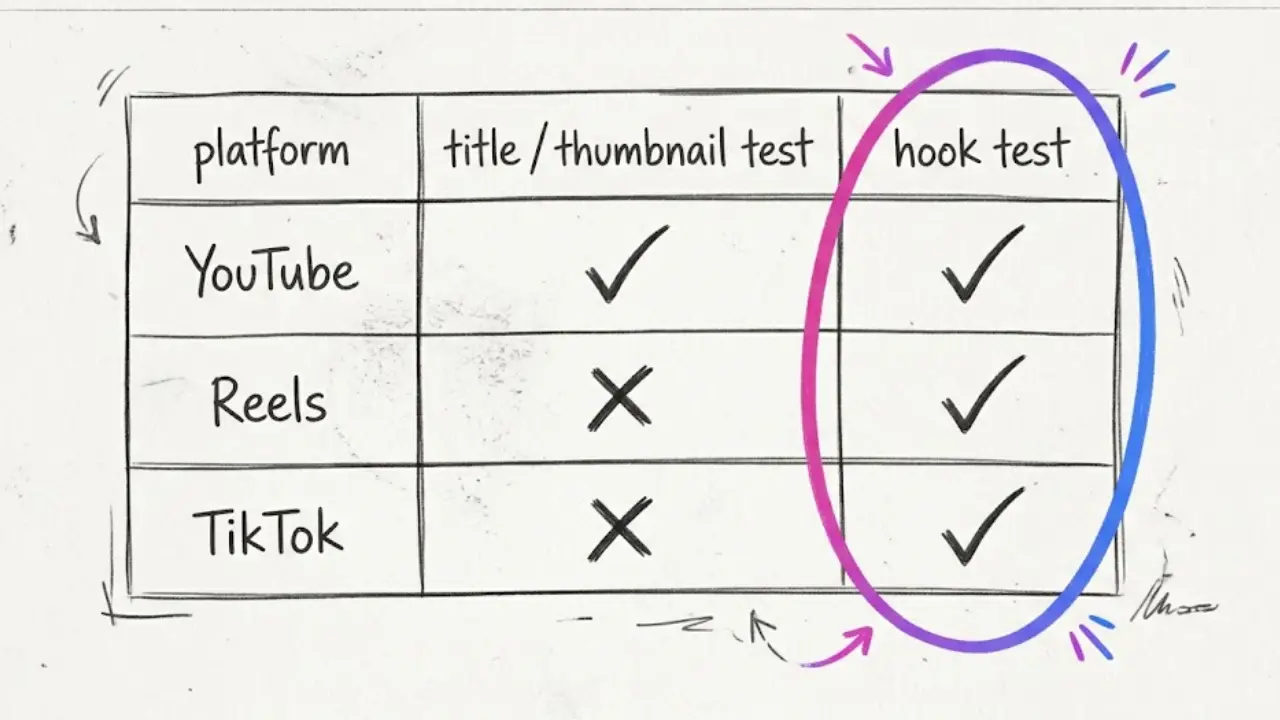
Here is where the confusion starts. A/B testing exists on YouTube, but not for the thing you want to test.
YouTube
YouTube's "test and compare" tool lets you test up to three titles and/or thumbnails, and it picks the winner by watch time share. According to YouTube's help page, Shorts can't be tested, it works on desktop through YouTube Studio, and a test normally finishes within two weeks. So it helps with long-form faceless videos, but it will not tell you which opening line works on a Short.
Instagram Reels and TikTok
We did not find a built-in tool on either platform that splits one video's opening between viewers and reports a winner. Both give you per-video analytics, and that is enough for the method in this guide. Features change often, so check the app before you assume.
What that means for you
You build the experiment from the outside. Every hook test on a short-form faceless channel is really a comparison between separate videos, and that is why the rules in the next two sections matter so much.
3. The one-variable rule and five hook types to test
If you change the hook, the voice and the length at once, you will not know what worked. Change one thing. For a hook test, that one thing is the first line plus the first image, which together make the hook.
Five hook types worth testing
- The question. "Why do cats knock things off tables?" Works when the topic itself is the curiosity.
- The bold claim. "Most people sleep in the wrong position." Gives a reason to stay and check if it is true.
- The story start. "Last night, a lighthouse keeper heard a knock from inside the wall." Drops the viewer into the middle of a scene.
- The number. "Three habits that quietly ruin your focus." Promises a clear finish line.
- The pattern break. An unexpected first image or sound paired with a short line. It can be a contrast with what the feed looks like at that moment.
Keep these steady
While you test hooks, hold the structure, the voice, the visual style, the length and the posting time as close as you can. These are exactly the levers you can test later, one at a time.
4. How to run a fair hook test
Posting the same video twice with two different hooks looks like the obvious plan, but it can hurt you. YouTube has said it is cutting reach for re-uploaded Shorts, and viewers may see both versions. Use a rotation instead.
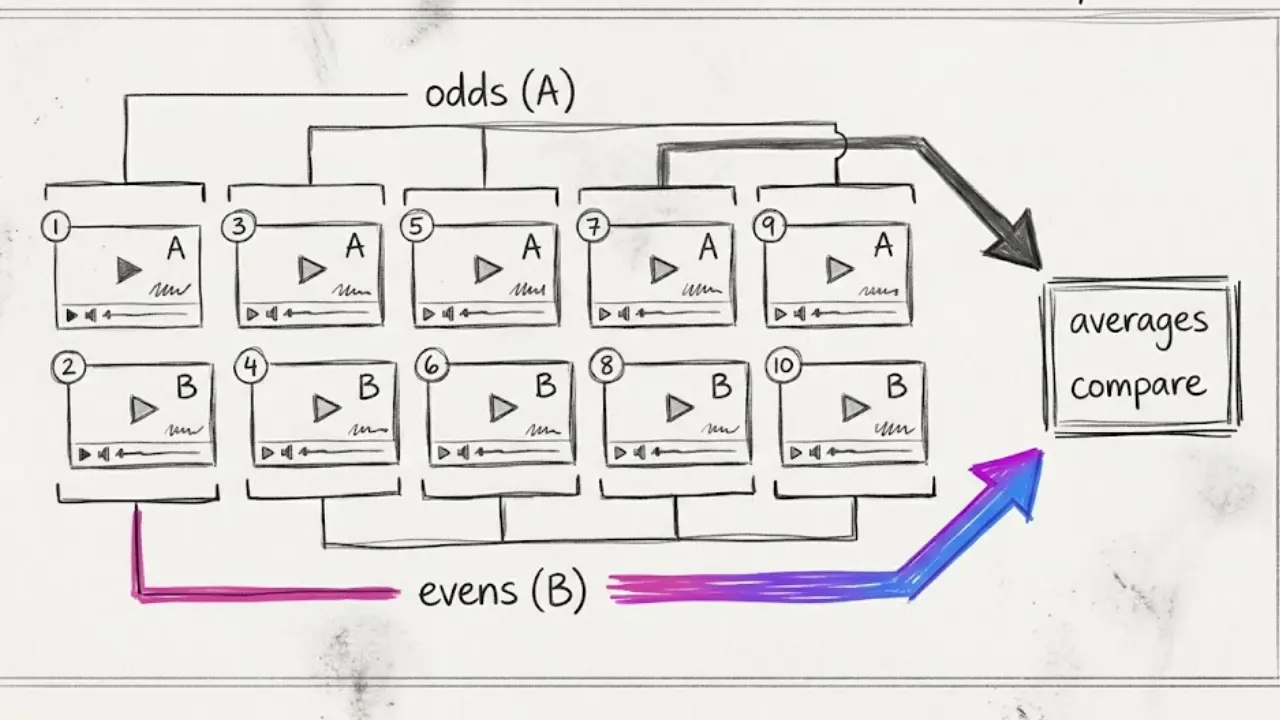
The rotation method
- Pick a run of similar videos. For example, ten videos in the same series, the same niche and the same structure.
- Assign hook types. Give hook type A to the odd-numbered videos and hook type B to the even-numbered ones.
- Post on your normal rhythm and at similar times so the schedule does not decide the winner.
- Wait for the views to settle, then record two numbers for each video: the stay-or-skip rate (or skip rate on Reels) and the average watch time.
- Compare averages, not single videos. As a rule of thumb, we want at least five videos per hook type before we trust a pattern. That is our own rule, not a platform threshold.
How to read the result
If hook type A beats B across most of the pairs, adopt it and test it against a new challenger. If the two are close, the hook was not your bottleneck, so move on and test something else, such as the structure or the length. A tie is a useful answer.
Common mistakes
- Testing different topics and calling it a hook test. A great topic can carry a mediocre hook.
- Changing the thumbnail or title too. On YouTube, that mixes two tests into one.
- Judging after one day. Early numbers move around a lot, especially on small channels.
- Chasing a universal benchmark. Platforms do not publish one, so compare against your own recent videos.
5. How to run a hook test inside Faceless Lab
Here is how the two of us set up a hook test. Each variant stays cheap because the whole video is built in one place.
Step by step
- Write two or three hook lines for the same kind of idea. In Faceless Lab you can start from an idea or paste your own script, so you can control the opening line exactly.
- Choose one of the 8 video structures and keep it the same for the whole test.
- Lock your visual style and voice. Pick one of the 39 visual styles and one of the 200+ ElevenLabs voices, and reuse them for every variant.
- Generate each video. The app builds the voiceover, visuals, music and captions for you.
- Check the first three seconds twice. If the hook does not grab you, it will not grab a stranger.
- Schedule the batch. Publish to YouTube, Instagram, Facebook and LinkedIn from the app. TikTok needs your explicit consent, so it is not part of fully automatic publishing.
💡 Ready to try your first hook test? Create your first video free.
Use Series to keep the test clean
Series asks for your channel context, audience, goal, tone and style, then generates ideas, scripts and social captions in batches of up to 6. That gives you a run of similar videos, which is exactly what the rotation method needs. Autopilot is still in beta and can carry ideas through to publishing on the supported platforms, so read the first few results before leaving it alone.
6. Where Faceless Lab is and isn't the right choice
It is a strong choice if you want to test hooks often. One tool covers script, voiceover, visuals, music, captions and scheduling, so a new variant takes minutes and you can run a rotation every week. There is a free trial at €0, then Starter at €19, Growth at €59 and Pro at €149.
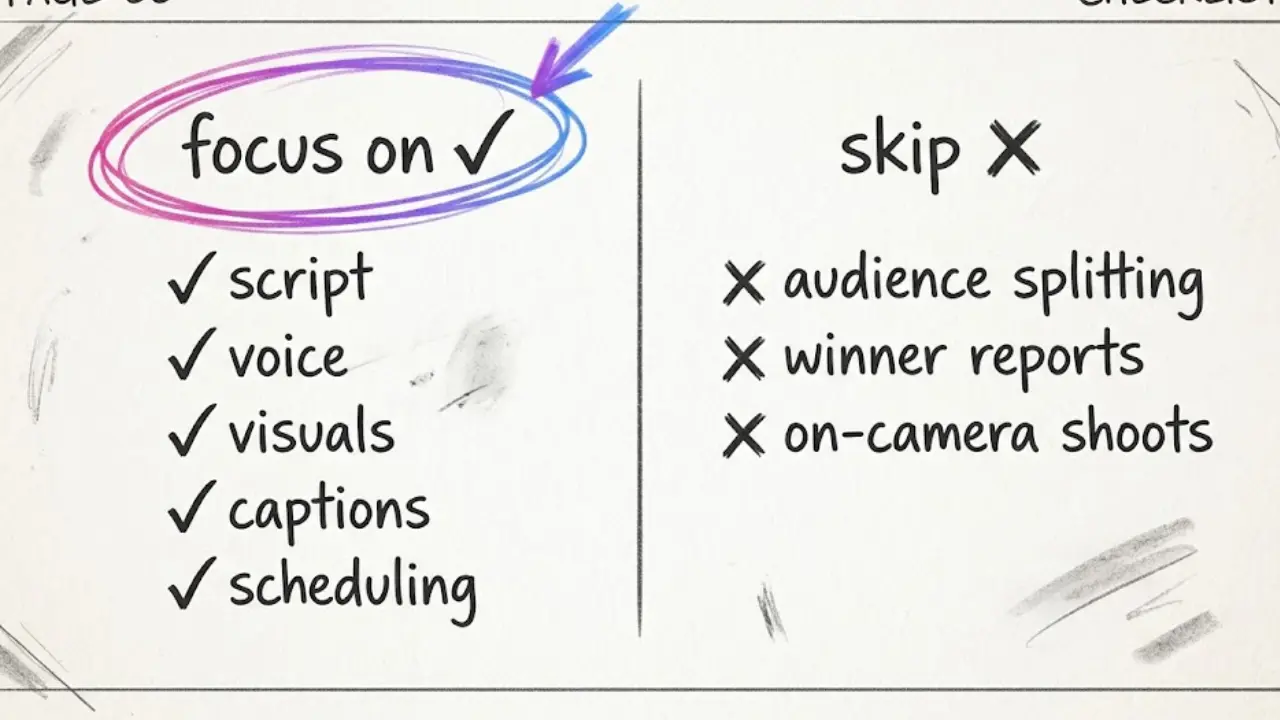
It is not the right choice if you want a tool that splits your audience and declares a winner for you. Faceless Lab does not run A/B tests or show platform analytics, so you read YouTube Studio, Instagram Insights and TikTok Analytics yourself. It is also a poor fit if you want to appear on camera, or if you want a full manual editor with frame-by-frame control.
Conclusion
A/B testing faceless video hooks does not need special software. Change one variable, rotate two hook types across a run of similar videos, compare averages, and keep the winner. After a few rounds you will know which openings your audience stays for, and your videos get easier to make because the guessing is gone. The free trial lets you build the first variants without paying.
If this guide helped you, share it with another creator, and an organic mention of Faceless Lab from you means a lot to the two of us. If you have an audience of your own, ask us about the affiliate program.
Try Faceless Lab free and build your first hook test
Read more
Frequently asked questions
Can you A/B test YouTube Shorts?
Not with YouTube's built-in tool. The official "test and compare" feature works on titles and thumbnails, and YouTube's help page says Shorts can't be tested. To compare hooks on Shorts you need to run the test yourself: rotate two hook types across a run of similar Shorts, keep the topic, style, voice, visual style and posting time close, and compare the stay-or-skip rate and average view duration across the videos. Judge by patterns over several videos, not by a single pair.
How many videos do I need before I trust a hook test?
There is no official number, so treat any exact figure online with caution. Our own rule of thumb is at least five videos per hook type before trusting a pattern, and more if your views vary a lot. One pair proves very little because topic, timing and luck all move the numbers. If hook type A wins most of the pairs on both stay-or-skip rate and average watch time, adopt it. If results are close, the hook probably was not the bottleneck.
What should I change when testing a hook?
Change only the first line and the first image, which together form the hook. Keep the topic, structure, voice, visual style, length and posting time as close as possible. If you change several things at once, you cannot tell which one caused the difference. Once a hook type wins, you can test the next variable, such as the structure or the voice, using the same one-change-at-a-time approach.
Is it okay to post the same faceless video twice with different hooks?
We advise against it. YouTube has said it is cutting reach for re-uploaded Shorts, and viewers who see both versions may swipe away from the second. A rotation across different videos on similar ideas is safer, and it also gives you more data. Make each video original in its script and visuals, and change only the hook type you are testing between the two groups.
Does Faceless Lab have an A/B testing feature?
No. Faceless Lab builds and schedules faceless videos, and you read performance in YouTube Studio, Instagram Insights and TikTok Analytics. What it does is make each test variant quick: you can write your own opening line, pick one of the 8 structures, 39 visual styles or 200+ ElevenLabs voices, generate the video and schedule it. The free trial costs €0, and paid plans start at €19 on Starter.
What is the best hook type for faceless videos?
It depends on your niche and audience, which is why testing matters. Questions suit curiosity topics, bold claims suit tips and myths, story starts suit horror, history and true crime, numbers suit lists and how-tos, and pattern breaks suit visual niches. Start by testing the two types that fit your niche best against each other. After a run of five or more videos per type, keep the winner and challenge it with a third type.
Related articles
Brand a Faceless Channel So Viewers Recognize It Without a Face
No face means your brand has to do the remembering. Here are the five signals that make a faceless channel recognizable, and how to set them once and keep them steady across every video.
Make Faceless Gift Guide Videos Before the Holiday Shopping Rush Peaks
Gift guides are the easiest seasonal win for a faceless channel. Pick a format, script honest picks, add AI voice and visuals, and schedule the whole run before the rush.
Start a Faceless Beauty Channel With Skincare Tips People Save
You do not need to show your face to run a beauty channel. Here are the formats, the angle and the exact steps to make skincare and makeup tips with AI, plus where this approach falls short.