Turn Ancient Stoic Wisdom Into Faceless Shorts People Actually Save
Stoic wisdom is one of the calmest, most rewatchable faceless niches on YouTube and TikTok. Here is how to turn Marcus Aurelius and Seneca into daily stoic shorts people save, without filming anything.

Stefano Ventrudo
CTO at Faceless Lab
A calm, first-person guide to building a faceless stoicism channel that runs on daily shorts, from picking your angle to publishing on a rhythm.
Can you build a faceless stoicism channel without ever recording your own voice or showing your face? Yes, and it might be one of the easiest niches to keep going. Faceless stoicism videos pair timeless lines from Marcus Aurelius and Seneca with slow, cinematic visuals and a steady voice, which means the whole thing can be scripted, narrated and assembled by AI. The audience is patient, the topics never expire, and the format rewards consistency more than production budget.
I am Roberto, one of the co-founders of Faceless Lab. Stefano and I run faceless channels every day, and philosophy shorts are one of the formats we keep coming back to because they are calm to make and calm to watch. This guide walks through why the niche works, what a stoic short actually needs, and how to produce one start to finish.
Executive summary: Stoicism is one of the strongest evergreen niches for faceless creators because the source material is public domain, deeply quotable and endlessly relevant to modern stress. A good stoic short is short (20 to 45 seconds), built on one clear idea, carried by a warm low voice, and paired with calm visuals like statues, storms, candlelight or quiet nature. Reported RPMs in the wider philosophy and self-improvement space sit around 5 to 12 dollars, and competition is still low relative to demand. Inside Faceless Lab you write or paste a script, pick a voice from the ElevenLabs library, choose a visual style and let the app generate the voiceover, visuals, music and captions, then schedule it to post daily. The niche fits short-form beautifully. If your plan is 15 minute lecture compilations, that is a different tool.
Table of Contents
- Why stoicism is one of the calmest faceless niches to run
- What makes a stoic short actually hold attention
- Pick an angle: stoic sub-niches worth your time
- Make a stoic short inside Faceless Lab, step by step
- Turn one stoic idea into a series that posts itself
- Where Faceless Lab fits, and where it doesn't
1. Why stoicism is one of the calmest faceless niches to run
Most faceless niches ask you to keep up with something. Trends move, algorithms shift, and last month's format stops working. Stoicism sits still. A line Marcus Aurelius wrote to himself almost two thousand years ago still lands on a Tuesday commute, and that stability is a gift when you are trying to post every day.
The source material is free and public domain. Marcus Aurelius, Seneca, Epictetus and the rest wrote in the public domain, so you can quote them directly without licensing anything. That removes the single biggest headache in most content niches.
The audience is unusually loyal. People who follow stoic accounts tend to save, rewatch and share. They come back because the content helps them, not because it shocks them. That behavior sends good signals to every platform and builds a following that sticks around.
The economics are friendly. Across the wider philosophy and self-improvement space, creators report RPMs in the range of 5 to 12 dollars, which is healthy for a niche you can produce entirely from a keyboard. Competition is still low compared to the size of the audience, especially in short-form where a lot of the older channels never bothered to show up.
2. What makes a stoic short actually hold attention
The mistake I see most often is treating a stoic short like a poster. Someone slaps a quote on a statue, adds a piano loop and wonders why it flatlined. A quote is not a video. A short idea that unfolds for thirty seconds is.
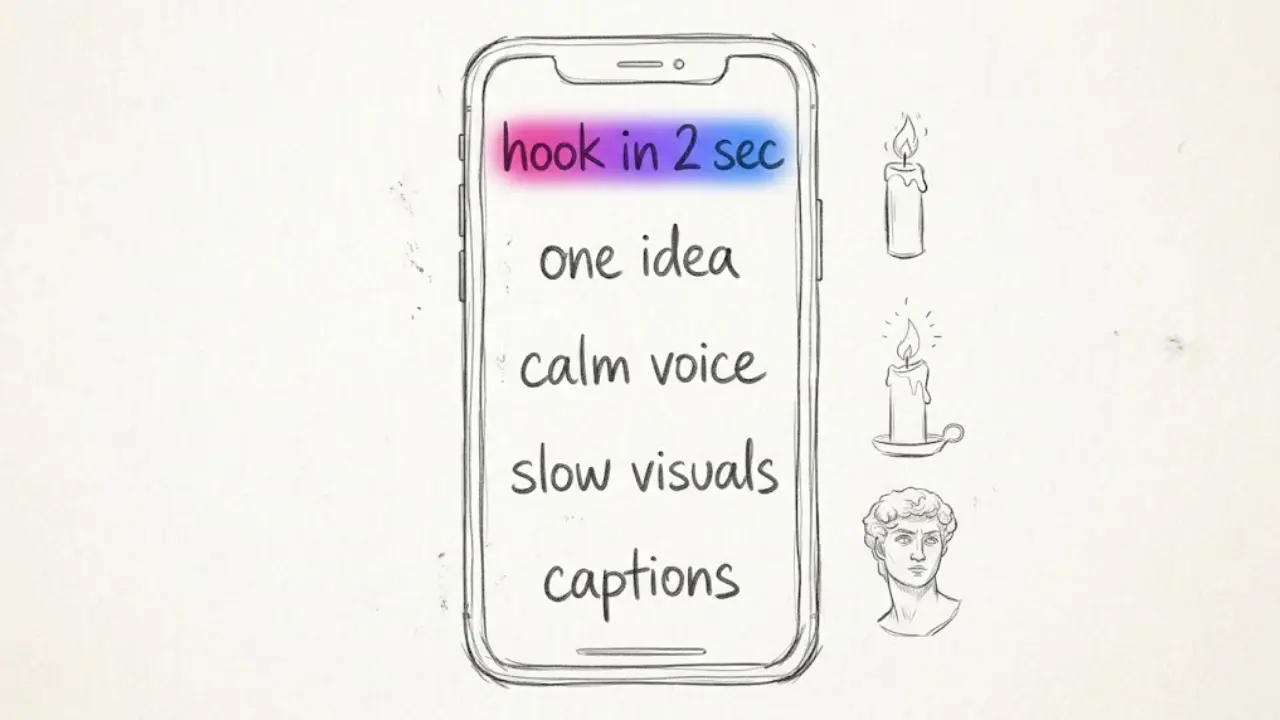
One idea per video. Pick a single tension and stay on it. "How to stop letting other people ruin your morning" is a video. "The complete philosophy of Epictetus" is a playlist. The tighter the idea, the harder it hits.
A hook in the first two seconds. Open with the problem, not the philosopher. "You are angry at something you cannot control" pulls people in faster than "Marcus Aurelius once said." Name the feeling first, then bring in the wisdom.
A voice that sounds like a calm friend, not a robot. This niche lives and dies on narration. A warm, slightly slow, low register works best. Rushed or synthetic delivery breaks the mood instantly.
Visuals that breathe. Slow pans over marble busts, storms rolling in, a single candle, quiet mountains at dawn. The images should support the words and never fight them. Fast cuts kill the calm.
Captions for the 80 percent watching on mute. Clean, well timed captions keep people reading when the sound is off, which is most of the time on a feed.
3. Pick an angle: stoic sub-niches worth your time
"Stoicism" is a category. A channel needs an angle so people know what they are subscribing to. Here are the ones that consistently pull.
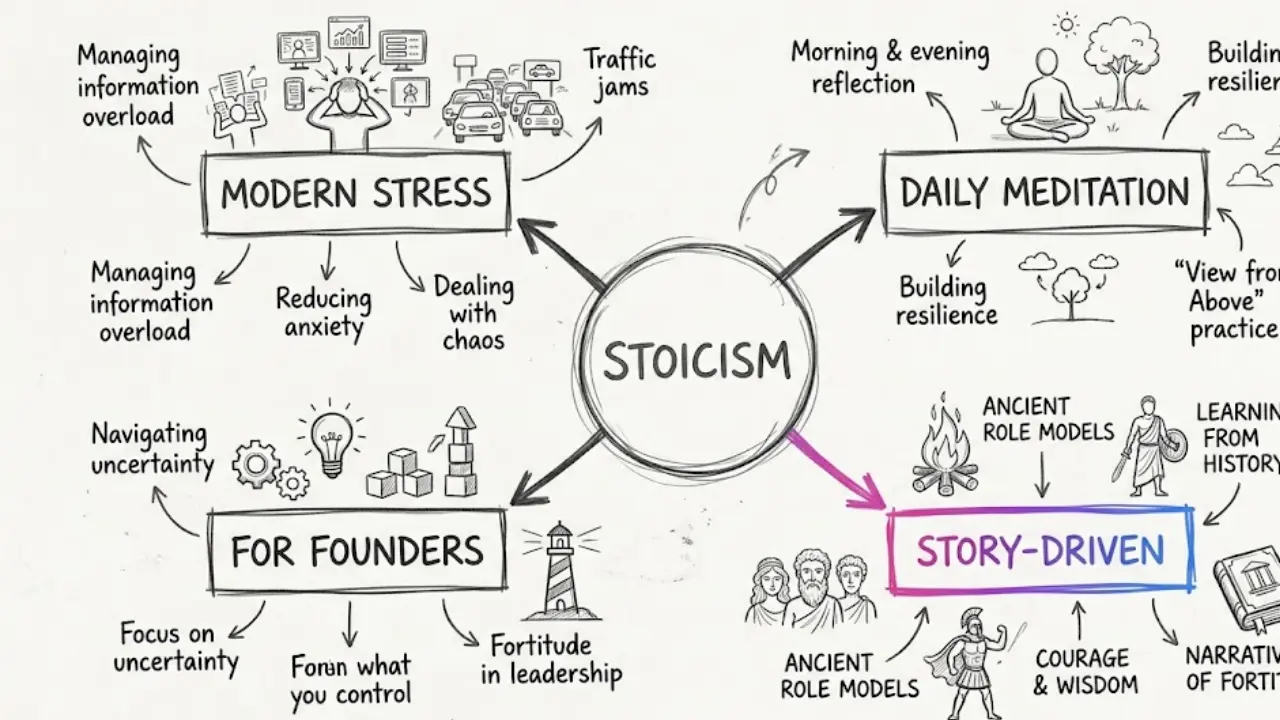
Modern stress, ancient answer
Take a hyper-specific modern problem and answer it with one stoic principle. "What Marcus Aurelius would tell you about a micromanaging boss." "The stoic way to handle being left on read." This is the biggest open gap right now, because most old philosophy channels stayed abstract and never got personal.
Daily meditation, one line at a time
Work straight through The Meditations or Seneca's letters, one short reflection per day. It gives you a near endless content calendar and trains your audience to come back every morning.
Stoicism for a specific person
Narrow the audience instead of the topic. Stoicism for founders, for athletes, for people going through a breakup, for anyone who cannot sleep at 3am. A clear "who this is for" beats a clear "what this is about" almost every time.
Story-driven stoicism
Wrap the lesson in a short scene. A soldier, a merchant, a king who lost everything and how a stoic idea carried them through. Narrative holds attention longer than instruction, and Faceless Lab includes story-shaped structures built for exactly this.
4. Make a stoic short inside Faceless Lab, step by step
Here is the actual workflow Stefano and I use. Start to publish-ready in a few minutes.
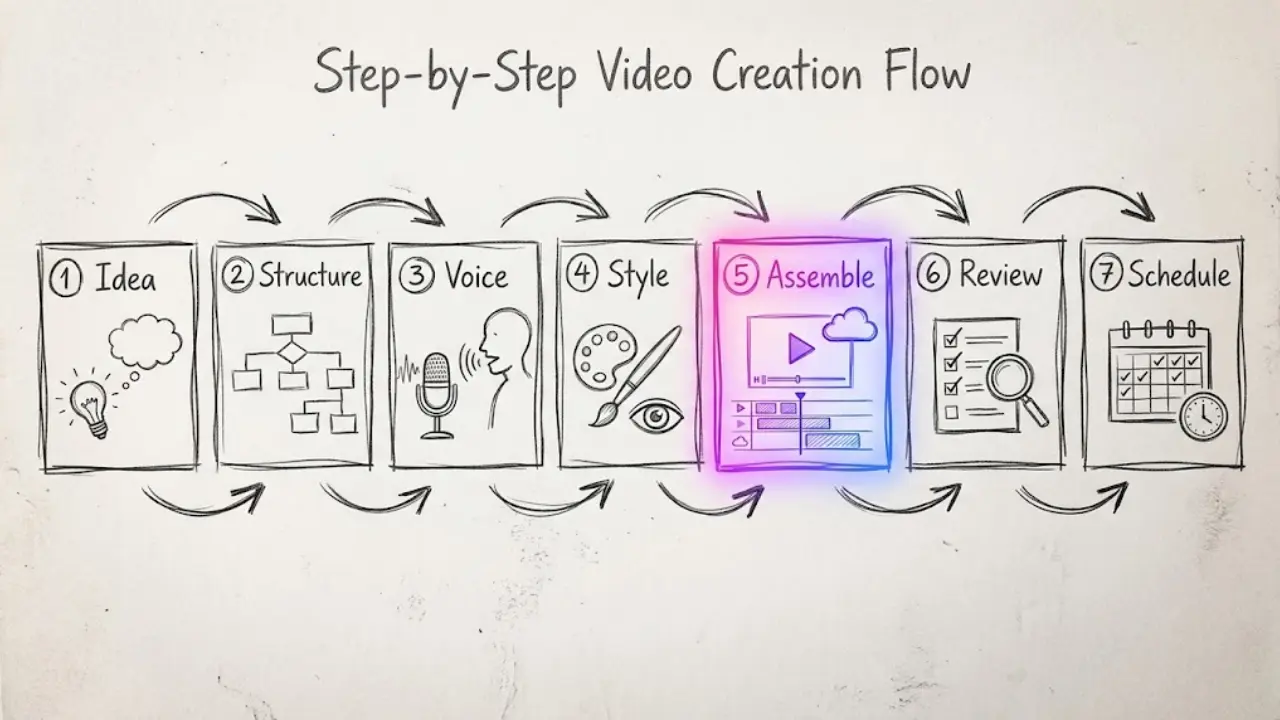
- Start from an idea or a script. Type a topic like "the stoic response to jealousy," or paste a script you already have. If you start from the idea, the app drafts the script for you, and you edit it until the hook and the closing line feel right.
- Choose a structure. Faceless Lab ships with 8 video structures. For stoicism, a hook then lesson then takeaway works well, and the story structure works when you want a small scene.
- Pick the voice. The voice library runs on ElevenLabs with more than 200 voices. For this niche, choose a low, warm, unhurried one and slow it down slightly. Preview two or three before you commit.
- Set the visual style. There are 39 visual styles to choose from. Lean into cinematic, muted, classical looks: marble, stormy skies, candlelight, quiet landscapes. Keep it consistent so the channel has one recognizable feel.
- Let it assemble voice, visuals, music and captions. The app generates the narration, matches visuals to each line, adds fitting background music and burns in captions. Generation usually takes a couple of minutes.
- Review and tighten. Watch it once. Adjust the script, swap a voice, change a scene or the music if anything breaks the calm. Small fixes here are the difference between fine and rewatchable.
- Schedule and publish. Send it to YouTube, Instagram, Facebook or LinkedIn on the schedule you set, or line up a week at once. A quick note on TikTok: fully automatic posting there is excluded and needs your explicit consent each time, which is by design.
💡 Ready to try it on your own idea? Create your first stoic short free.
5. Turn one stoic idea into a series that posts itself
A single good video is nice. A series is a channel. This is where faceless stoicism stops being a hobby and starts running quietly in the background.
Batch on one theme. Sit down once and produce ten shorts around a single thread, say ten stoic answers to everyday anger. You stay in one headspace, the voice and style stay consistent, and you walk away with two weeks of posts.
Use Series to keep the thread going. The Series feature is built to turn one concept into an ongoing run of videos that share a look and a rhythm, so episode nine feels like it belongs with episode one.
Let Autopilot carry the calendar. Autopilot, currently in beta, is designed to keep the channel posting on a schedule with less manual work from you. You batch on a Sunday, and the week fills itself in.
The whole point of stoic content is steadiness, and a channel that posts steadily mirrors the message. That alignment is part of why the niche grows so reliably.
6. Where Faceless Lab fits, and where it doesn't
I would rather you start with clear eyes than feel misled later, so here is the honest boundary.
Where it fits well. Faceless Lab is built for short-form. Daily stoic shorts of 20 to 60 seconds for YouTube Shorts, Reels, TikTok and LinkedIn are right in the middle of what the app does best. Script, voice, visuals, music, captions, scheduling, all in one place, on a rhythm you can actually keep. If your plan is a daily stoic channel, this is a strong fit.
Where it doesn't. If your dream is 15 minute lecture-style compilations or hour-long ambient philosophy for sleep, that is long-form, and Faceless Lab focuses on short pieces. You can build the short-form top of your funnel here and produce the long stuff elsewhere, but do not expect this tool to be a long-video editor.
On pricing, plainly. You can start on the Free trial at 0 euro to make real videos and see if the fit is there. Paid plans are Starter at 19 euro, Growth at 59 euro and Pro at 149 euro per month, with limits that reset monthly and cancellation any time. Pick the plan that matches how many videos you actually publish, not the biggest one.
A stoic would tell you to test cheaply before you commit, and that is exactly the right way to approach any tool, ours included.
Start free, post one stoic short a day for two weeks, and watch which ones people save. That single habit will teach you more than any guide, and it costs you almost nothing to begin.
If a video helps you, the kindest thing you can do is repost it and pass it on. And if you end up loving the workflow, our affiliate program lets you earn by sharing Faceless Lab with other creators who are tired of the editing grind.
Try Faceless Lab free and make your first stoic short today.
Read more
Frequently asked questions
Is a faceless stoicism channel actually profitable?
It can be, and it is one of the friendlier niches to monetize. Across the wider philosophy and self-improvement space, creators report RPMs in the range of 5 to 12 dollars, which is solid for content you can produce entirely from a keyboard. The bigger advantage is longevity. Stoic videos do not expire, so an upload can keep earning for months or years. Profit still depends on consistency and volume, so treat it as a channel you post to daily rather than a quick win. Start on the Free plan, prove the format works for you, then scale your output once a few videos gain traction.
Do I need to show my face or use my own voice?
No, and that is the whole point of the format. Faceless stoicism videos work because the wisdom carries the video, not a presenter. You script the idea, choose a voice from a library of more than 200 AI voices, and pair it with calm visuals. Nobody needs to know who is behind the channel. Pick a low, warm, unhurried voice and keep it consistent so viewers start to recognize the sound of your channel. Your presence comes through in the choice of ideas and the tone you set, not in a camera pointed at your face.
How long should a stoic short be?
For short-form on YouTube Shorts, Reels and TikTok, aim for 20 to 45 seconds. That is long enough to open with a problem, land one stoic idea and close on a memorable line, and short enough to hold attention to the end. Watch-through matters more than length, so cut anything that does not serve the single idea. If a thought genuinely needs more room, split it into two shorts rather than stretching one. Longer lecture-style videos of 8 to 12 minutes exist in this niche too, but those are a different, long-form workflow.
Where do I get the visuals without filming anything?
Inside Faceless Lab the visuals are generated for you and matched to your script, so you never source or shoot footage. You choose from 39 visual styles, and for stoicism the cinematic, muted, classical looks work best: marble statues, stormy skies, candlelight, quiet landscapes. Keeping one consistent style across your videos is what makes a channel feel intentional rather than random. The app handles pairing each line of narration with a fitting visual, adds background music and burns in captions, then hands you a video you can review and adjust before it publishes.
Can I really post a stoic video every day without burning out?
Yes, if you batch instead of making one at a time. Set aside one session, produce ten shorts around a single theme, and you have two weeks of posts ready. The Series feature keeps the look and rhythm consistent across a run, and Autopilot, currently in beta, is built to keep the channel posting on schedule with less manual work. The daily grind that burns people out is the editing, and that is the part the app removes. Your job becomes choosing good ideas, which is the enjoyable part of running a philosophy channel anyway.
Is quoting Marcus Aurelius or Seneca a copyright problem?
The original writings of Marcus Aurelius, Seneca and Epictetus are in the public domain, so quoting them directly is fine. Be a little more careful with modern translations, since a specific recent English translation can carry its own copyright. The safest path is to paraphrase the idea in your own words or use older public-domain translations, which also tends to make the language feel more natural in a short. The music and visuals generated inside Faceless Lab are cleared for you to publish, so your main thing to watch is which translation you lean on.
Related articles
Turn Study and Productivity Tips Into Faceless Shorts People Save for Later
Exam season and New Year planning send people searching for study and productivity tips. Learn how to pick a promise, write useful shorts and schedule a faceless productivity channel without filming.
Dog and Cat Tips Make a Faceless Channel That Owners Come Back To
Pet owners search for tips every day, and each answer fits one short. Learn how to pick an audience, write safe tips, and publish a faceless dog and cat channel without ever filming.
Faceless What If Videos Are the Easiest Way to Turn Curiosity Into Views
Curiosity sells, and you never have to show your face. Here is how to make faceless what if videos with AI, which formats hold attention, and how to turn one idea into a daily series.