Dog and Cat Tips Make a Faceless Channel That Owners Come Back To
Pet owners search for tips every day, and each answer fits one short. Learn how to pick an audience, write safe tips, and publish a faceless dog and cat channel without ever filming.

Roberto Pasqualini
CMO at Faceless Lab
How to start a faceless pet channel, from choosing your audience to writing safe tips, making the video and posting every day.
How do you start a faceless pet channel when you have no camera-ready dog and no wish to appear on screen? You teach what pet owners keep searching for: why the cat kneads, how to stop the leash pulling, what that tail wag really says. Those answers work as narrated shorts with AI visuals, and the person speaking never has to be you. We are Stefano and Roberto, the co-founders of Faceless Lab, and this is how we would build a pet channel from zero today.
Executive Summary
A faceless pet channel works because pet owners ask the same practical questions every day, each question fits one short video, and the answers stay useful for years. The channels that grow choose one audience (new puppy owners, cat behavior, senior dogs), open every short with the problem the owner is living through, keep advice general and safe, and post on a steady rhythm. With Faceless Lab you can turn one question into a scripted, voiced and captioned short with AI visuals and music in minutes, group episodes into a Series and schedule them to YouTube, Instagram, Facebook and LinkedIn, starting on a free trial.
Table of Contents
- Why pet content works as faceless video
- Pick one pet audience and one promise
- Write a pet tip short that earns the follow
- Keep the advice safe and the channel monetizable
- How to make a pet tips short inside Faceless Lab
- Where Faceless Lab is (and is not) the right choice
- Conclusion
1. Why pet content works as faceless video
Pet owners are some of the most loyal viewers on the internet. They love their animal, they worry about doing things right, and they search for answers at all hours. That combination gives a pet channel a ready audience before you post a single video.
Every question is a ready-made video
- Problems are specific. "Why does my dog follow me into the bathroom?" is a complete episode with a hook, an explanation and a tip.
- Answers are short. Most behavior questions can be answered in 30 to 45 seconds, which fits Shorts, Reels and TikTok.
- The visuals are easy. Viewers want to see a dog, a cat or a puppy doing the thing you describe. AI visuals can show that scene, so nobody misses a presenter.
Owners save and share
A good tip gets saved for later and sent to a partner or a friend who just adopted a puppy. Saves and shares are exactly the signals the platforms reward, and pet tips collect them naturally.
The topic does not expire
How to introduce a new kitten to an older cat will be just as relevant next year. Your back catalog keeps finding new owners, which is a big advantage over news or trend channels.
2. Pick one pet audience and one promise
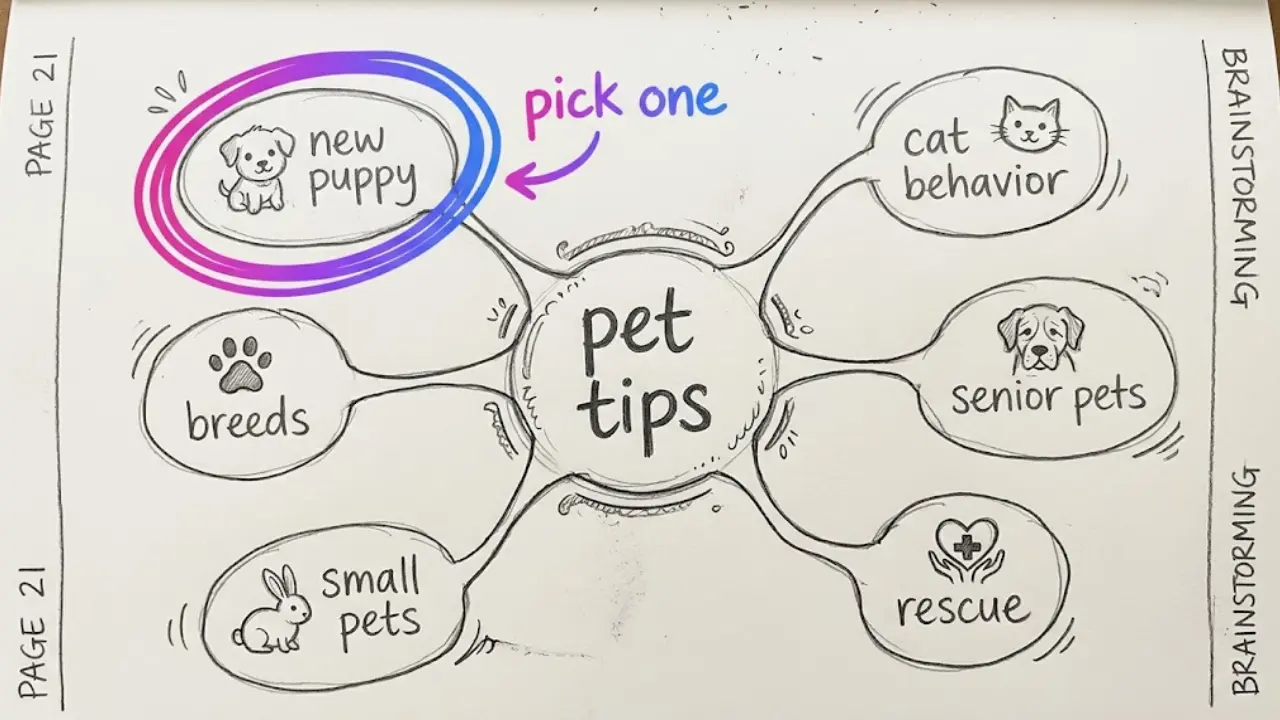
"Pet tips" is too wide to build a channel on. A new visitor should understand in two seconds who the channel is for and what they will get. Choose an audience and a promise, and say both on your profile.
Audiences with room to grow
- New puppy owners. Crate training, biting, first vet visits, the first week at home. A huge group that is actively searching.
- Cat behavior explained. Why cats knead, chatter at birds, bring you "gifts" or sit in boxes. Pure curiosity with an easy tip at the end.
- Senior pet care. Comfort, mobility, routines for older dogs and cats. A smaller group with strong loyalty.
- Adopting and rescue. What to expect in the first 30 days with a shelter dog or cat.
- Small pets. Rabbits, hamsters, guinea pigs, aquarium fish. Far less competition than dogs and cats.
- Pet breed profiles. One breed per video: temperament, exercise needs, common surprises.
Choose with a simple test
Pick the audience you could write 30 episode ideas for in ten minutes. If you run dry at ten, it is too narrow. If every idea could sit on any pet channel, it is too broad.
Lock one voice and one look
Once you choose, keep the same narrator voice and the same visual style on every episode. A warm, friendly voice and soft illustrated visuals suit new owners, while a calmer documentary tone suits senior care. Consistency makes your shorts recognizable in a busy feed.
3. Write a pet tip short that earns the follow
Pet owners follow channels that solve a problem they have right now. So open with that problem, not with a greeting or a breed name.
A script structure that works
- Hook (first line). Name the problem in the owner's words. "Your dog pulls on the leash and every walk feels like a fight."
- Reason. One plain sentence on why it happens. "Pulling works for them, because it gets them where they want to go."
- The tip. One action the owner can try today, explained in two or three short lines.
- Common mistake. The thing most owners do that makes it worse. This is often the most shared part.
- Loop or question. End with a question for the comments ("What did your dog do first?") or a line that flows back into the hook.
Write for the ear
- Keep each sentence short enough to say in one breath.
- Speak to "you" and "your dog" or "your cat".
- At 30 seconds, aim for roughly 75 to 90 spoken words. Cut anything that does not help the owner act.
Hooks we would test
- "If your cat does this, it is not angry at you."
- "Stop doing this in the first week with your puppy."
- "Here is why your dog stares at you while you eat."
- "Three signs your older dog needs a softer bed."
4. Keep the advice safe and the channel monetizable
Pet content carries a responsibility that most niches do not. People act on what you say, and an animal can be hurt by bad advice. Trust is the whole asset of a pet channel, so protect it from day one.
Build a safety habit
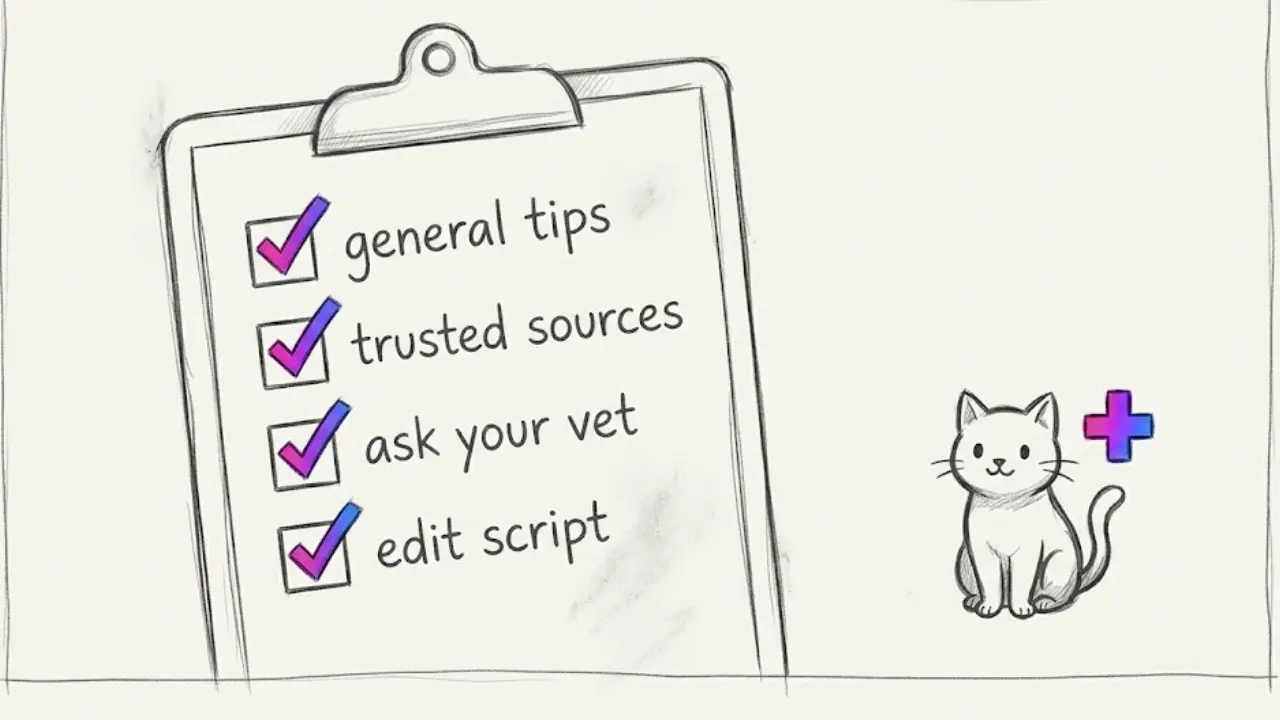
- Stay general. Teach behavior, training basics, routines and comfort. Do not diagnose illness or recommend doses, medicines or treatments.
- Send health questions to a vet. Add a short line such as "if this is new or sudden, check with your vet" to anything that touches health.
- Use reliable sources. Veterinary school pages, established shelters and humane societies, and professional trainer and behaviorist organizations. When two sources disagree, soften the claim.
- Edit the AI script. An AI draft is a starting point. Read it, check every claim and cut anything you cannot confirm.
- Skip risky tricks. Avoid anything involving harsh punishment, human food that may be toxic, or "home remedies" for pets.
Keep it original
YouTube's inauthentic content policy targets mass-produced, repetitive uploads, and faceless channels are allowed. What gets flagged is a pile of near-identical videos with only the animal swapped. Vary your structures, write real scripts and give each episode a specific problem and a specific tip, and your channel will feel like a show.
Do not copy other creators' pet footage
Viral clips of real pets belong to the people who filmed them. Use AI visuals or properly licensed material, and never re-upload someone else's video as your own. That also protects you from reach penalties on re-uploaded content.
5. How to make a pet tips short inside Faceless Lab
This is the workflow we use, from blank page to scheduled video. Once your channel settings are in place, each short takes only a few minutes.
Step 1: Start with one question
Open the dashboard and type the owner's problem, for example "why does my cat knead blankets". If you already wrote a script, paste it in and Faceless Lab uses your text as the script.
Step 2: Choose a structure
Pick one of the 8 video structures. A problem, solution and call to action structure suits training tips, a ranked list suits "5 signs your dog is happy", and a story-style structure suits rescue and adoption episodes.
Step 3: Review and edit the script
Read the draft, check each claim against your source and add the vet reminder where health comes up. This is where your channel earns its credibility, so do not skip it.
Step 4: Pick a voice
Choose from more than 200 ElevenLabs voices. A warm, friendly voice works well for new owners. Use the same one on every episode so people recognize it.
Step 5: Lock your visual style
Choose one of the 39 visual styles and stay with it. You can also choose which AI image model generates the scenes, since Faceless Lab runs several models through Replicate, which helps when one model draws fur or faces better than another. Use the character consistency option when you want the same dog or cat to appear across a Series.
Step 6: Captions and music
Captions are generated automatically and you can adjust them. Add background music from the library, where licensing is clearly indicated.
Step 7: Turn it into a Series and schedule it
Save the setup as a Series so every episode keeps the same voice, style and structure. Then schedule it to publish automatically on YouTube, Instagram, Facebook and LinkedIn. TikTok publishing needs your explicit consent each time, so it is not fully hands-off there. If you want to go further, Autopilot (currently in beta) can keep a Series running on a rhythm you set.
💡 Ready to try it on your first pet tip? Create your free Faceless Lab account and make one short today.
6. Where Faceless Lab is (and is not) the right choice
We want you on the tool that fits your channel, so here is our honest take.

Faceless Lab is a good fit if
- You want to publish pet tips every day without editing each video by hand.
- You like the idea of a Series that keeps your voice, style and character consistent.
- You want scheduling and auto-publishing in the same place you create.
- You want to start free and pay only when the channel proves itself. Plans are Free trial €0, Starter €19, Growth €59 and Pro €149 per month.
It is probably not the right choice if
- Your channel is built on your own pet's real footage. Faceless Lab generates AI visuals, or you can bring your own content. If the charm is your actual dog, a regular phone editor is a better home for those clips.
- You want to give veterinary or medical advice. That needs a qualified professional, whatever tool you use.
- You make long documentaries. We focus on short-form and support videos up to 5 minutes. A 20-minute deep dive needs a different workflow.
- You want frame-by-frame timeline control. If you enjoy keyframing every cut, a full video editor will give you more manual control.
7. Conclusion
Pet tips are one of the most dependable faceless niches to start. Owners have endless questions, the answers fit a short, and viewers come back to the channels they trust. The ones that win choose a clear audience, open every short with the owner's problem, keep their advice safe and keep a rhythm they can hold for months.
Our verdict: if you want a faceless niche with a loyal audience and a topic that never runs out, pet tips are a strong place to begin. Make 10 episodes for one audience, see which ones get saved and shared, and build on those.
You can make your first pet tip short on the free trial before paying anything. If this guide helped, share it with a friend who keeps saying they will start a channel, and if you already love Faceless Lab, ask us about our affiliate program.
Try Faceless Lab free and make your first pet tips short
Read more
Frequently asked questions
Can you run a pet channel without showing your face or your own pet?
Yes. Most pet tip channels are narrated explainers, so the audience cares about the advice and the visuals, not the presenter. AI visuals can show a dog, a cat or a rabbit doing the behavior you describe, and a narrator voice reads the script. You can also keep the same character across a Series for a recognizable look. The only limit is honesty about what you show. Do not present generated scenes as real footage of a real pet, and keep your advice general and responsible.
What is the best niche for a faceless pet channel?
The best niche is the one you can write 30 episode ideas for quickly. New puppy owners, cat behavior explained and senior pet care all have steady search demand and clear problems to solve. Small pets such as rabbits, hamsters and aquarium fish have less competition than dogs and cats. Pick one audience and one promise, put both in your profile, and keep the same voice and visual style on every video so new viewers know what they are following.
Is it safe to give pet advice in AI-made videos?
It is safe when you keep the advice general and check it. Stick to behavior, training basics, routines and comfort. Do not diagnose illness or suggest medicines, doses or home remedies, and add a line telling owners to ask their vet when something is new or sudden. Build scripts from reliable sources such as veterinary school pages, shelters and professional trainer organizations, and always edit the AI draft yourself. Pet owners act on what they hear, so accuracy protects both animals and your reputation.
Can a faceless pet channel be monetized on YouTube?
It can, as long as the channel follows YouTube Partner Program rules. AI visuals and voices are allowed. Channels run into trouble with mass-produced, near-identical uploads or re-uploaded clips that belong to someone else. Write original scripts, vary your structures, give each video a specific problem and tip, and avoid copying other creators' pet footage. Entry requirements for new applicants change over time, so check YouTube's official Partner Program page for the current thresholds before planning your timeline.
How long should a faceless pet tip video be?
For most tips, 30 to 45 seconds is a good target. That fits a hook, a one-sentence reason, the tip itself, a common mistake and a closing question, which is roughly 75 to 110 spoken words. Ranked lists such as five signs your dog is happy can run close to a minute, since each item acts as a small payoff. Watch your completion rate. If viewers leave before the end, cut words before adding seconds. Faceless Lab supports short-form videos and longer ones up to 5 minutes.
How much does it cost to run a faceless pet channel with Faceless Lab?
You can start on the Free trial at €0 and make your first videos before paying. When you want to publish more often, the paid plans are Starter at €19, Growth at €59 and Pro at €149 per month, with usage limits that reset monthly and the option to cancel anytime. Yearly billing saves about 20%. Scripts, voiceover, AI visuals, captions, music, scheduling and auto-publishing live in one workflow, so you do not need separate tools to get a finished short out.
Related articles
Faceless What If Videos Are the Easiest Way to Turn Curiosity Into Views
Curiosity sells, and you never have to show your face. Here is how to make faceless what if videos with AI, which formats hold attention, and how to turn one idea into a daily series.
Keep the Same Character in Every Faceless Video Without Redrawing Anything
AI characters tend to change face, outfit and style from one video to the next. Here is how to keep one recurring character across a whole faceless channel, step by step.
Turn Everyday Life Hacks Into Faceless Videos People Save and Share
Life hacks are short, useful and easy to share. Here is how to build a faceless life hacks channel with AI, from formats and testing to a month of scheduled videos.