True Crime Is Made for Faceless Video. Here Is How to Do It Right
True crime is one of the most watchable faceless niches, and it does not need your face or voice. Here is how to make faceless true crime videos that hold attention and stay monetizable.

Stefano Ventrudo
CTO at Faceless Lab
A practical guide to making faceless true crime videos that hook fast, hold attention, and stay on the right side of the platform rules.
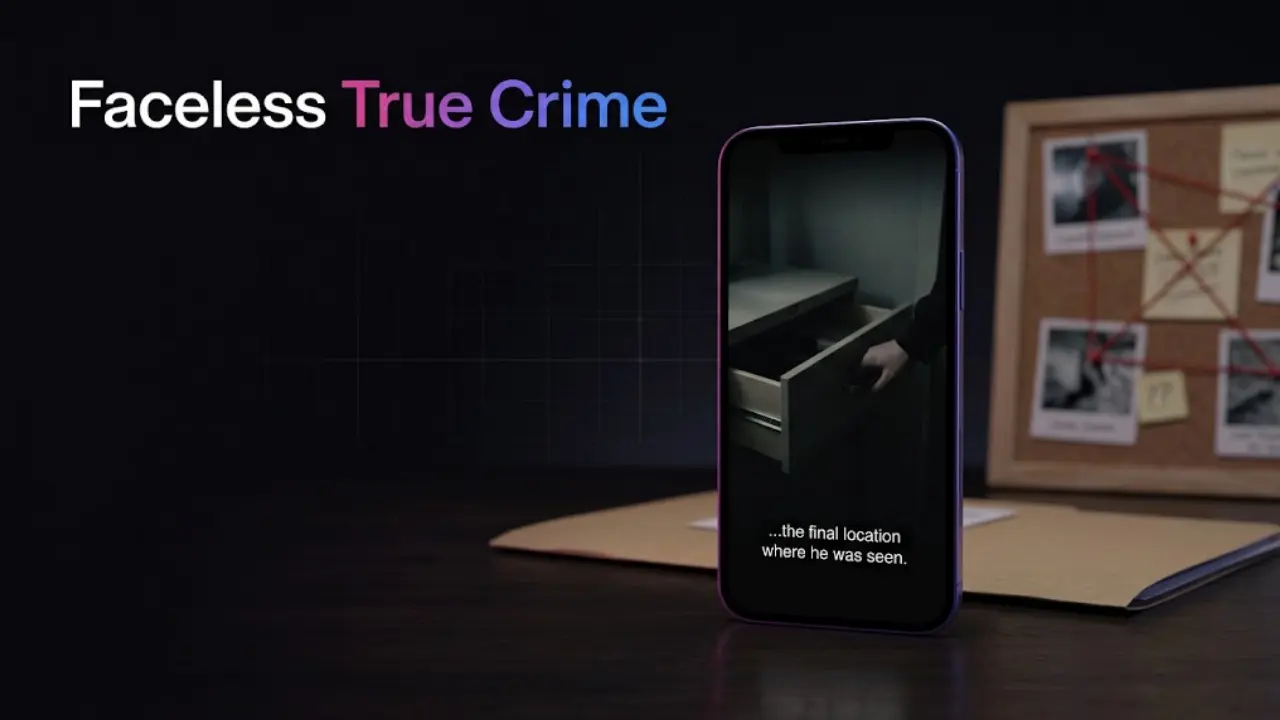
How do you make faceless true crime videos without ever showing your face or recording your own voice? It is one of the questions we get most often at Faceless Lab, and it makes sense. True crime is one of the most watched categories on YouTube and short-form feeds, the audience is huge, and almost none of it needs a person on camera. A steady narrator, a dark cinematic look, a tight script, and a real case are enough. That is exactly the kind of video this tool was built to produce.
The catch is that true crime is also crowded and easy to do badly. A flat AI voice reading a Wikipedia summary over stock footage gets ignored, and lately it gets demonetized too. This guide walks through the formats that actually work, how to write a script that grabs someone in three seconds, and how to build the whole thing start to finish, responsibly.
Executive Summary: Faceless true crime works because the genre runs on narration and atmosphere rather than a presenter, which means you can build a whole channel from research, a script, and a consistent dark visual style. The winning approach in 2026 is to pick one clear format (a short unsolved-mystery teaser, a timeline breakdown, or a "what really happened" explainer), open on the single most gripping moment of the case, keep one narrator voice and one look across every episode, and add real value through your own research and framing rather than a copy-paste summary. Inside Faceless Lab you write or paste the case, pick a documentary structure, choose a calm authoritative voice, generate cinematic visuals and captions, then schedule the video to publish on a rhythm. The tools make production fast. Your judgment, accuracy, and original angle are what keep the channel growing and monetizable.
Table of Contents
- Why true crime is made for faceless video
- The true crime formats that hold attention
- Write a true crime script that hooks in the first three seconds
- Choose the voice, visuals, and music that set the tone
- Make a faceless true crime video inside Faceless Lab
- Where Faceless Lab is and isn't the right choice
- Publish on a schedule and keep the channel monetizable
1. Why true crime is made for faceless video
Most niches ask you to build a personality. True crime asks you to tell a story well. The audience is there for the case, the tension, and the resolution, and they do not care whether a human is on screen. That is why so many of the biggest true crime channels are already narration over visuals, with no host in sight.
The genre fits the faceless workflow almost perfectly.
- Narration carries the whole thing. A calm, steady voice reading a well-paced script is the core of the format. You do not need a face, a set, or a camera.
- Atmosphere beats production budget. Dark tones, slow visuals, and the right music do more for a true crime video than any expensive shoot would.
- The source material never runs out. Historical cases, cold cases, court records, and public reporting give you a near-endless pipeline of topics.
- It travels across platforms. The same case works as a 45-second Short, a longer YouTube video, a Reel, and a Facebook video, so one idea can feed several channels.
A note on demand. Personal finance and true crime are regularly cited among the higher-earning faceless categories, with reported RPMs often in the mid-double digits, though the exact number depends on your audience, region, and how advertiser-friendly your content is. Treat any single figure you see online as a rough guide, not a promise.
2. The true crime formats that hold attention
The mistake most new creators make is trying to narrate an entire case with no shape. Pick a format first, because the format decides your pacing, your length, and your hook.
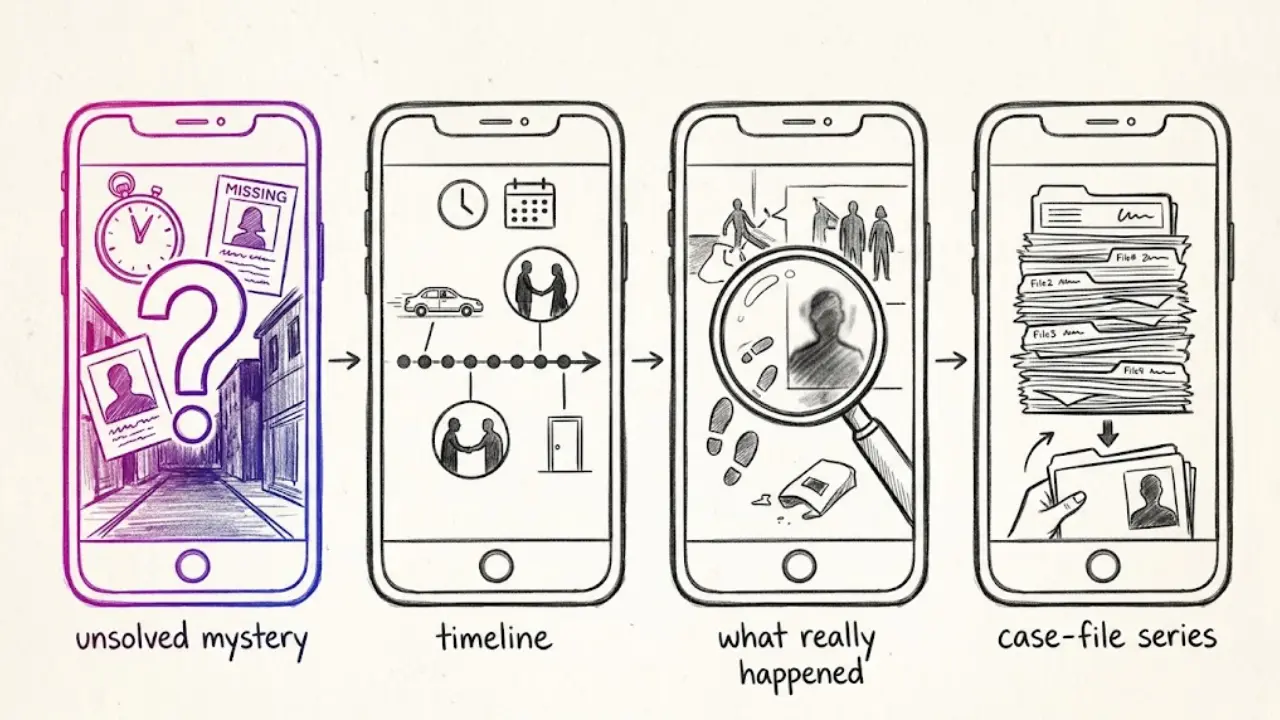
The unsolved-mystery teaser
A 30 to 60 second Short built around one unanswered question. You open on the strangest detail, lay out three or four facts, and end on the mystery still open. These do well because the comment section fills up with theories, and that engagement pushes reach.
The timeline breakdown
You take a single case and walk it in order, from the first event to the outcome. This suits slightly longer videos, 60 seconds up to a few minutes, and it works because a clear sequence keeps people watching to find out what happened next.
The "what really happened" explainer
You take a case people think they know and correct the record with the actual reporting. This format rewards research and gives you a genuine reason to exist beyond repeating what everyone else posted.
The case-file series
You turn one theme (unsolved disappearances, historical heists, forensic firsts) into a recurring series where each episode is one case. Series build the strongest channels because viewers subscribe for the next one.
3. Write a true crime script that hooks in the first three seconds
In short-form, the first line decides whether the video lives or dies. For true crime, that means you never open with "In the year..." or a slow biography. You open in the middle of the tension.

Strong openers to model:
- Drop them into the strangest moment. "The car was still running. The doors were locked from the inside. She was gone." Then step back and explain.
- Lead with the unanswered question. "Three witnesses. Three completely different descriptions. Only one of them could be telling the truth."
- State the stakes plainly. "This case sat cold for twenty years, until a single receipt reopened it."
After the hook, keep the script tight. Short sentences. One idea per line, because the narration and captions have to land at reading speed. Build toward a payoff, and if the case is unsolved, say so clearly and turn it into a question for the comments rather than pretending you have an ending.
A few rules that keep you safe and credible:
- Stick to what is reported. State facts that come from public reporting and court records. Avoid naming private individuals as guilty of crimes they were not convicted of.
- Separate fact from theory. If you are speculating, say "one theory is" instead of stating it as truth.
- Respect the people involved. Real cases involve real victims and families. A respectful tone is both the right call and the one platforms reward.
4. Choose the voice, visuals, and music that set the tone
True crime lives or dies on mood. Get the voice, the look, and the sound consistent and your channel feels like a real show instead of a random upload.
Voice
You want calm, clear, and steady. Not theatrical, not breathless. Faceless Lab gives you access to more than 200 ElevenLabs voices, so you can audition a few and lock in one narrator that becomes the sound of your channel. Consistency matters more than picking the "perfect" voice, so once it works, keep it.
Visuals
Dark, cinematic, and slow. Faceless Lab offers 39 visual styles and pulls from multiple image and video models through Replicate, so you can settle on one moody look (muted color, film grain, slow movement) and hold it across every episode. A consistent style is what makes a feed of your videos look like a brand.
Music and captions
A low, tense background bed under the narration does most of the emotional work. Keep it quiet enough that the voice stays clear. Captions are non-negotiable for true crime, because a lot of people watch on mute, and clean synced subtitles keep them reading along. Faceless Lab generates the captions automatically so you are not cleaning up timings by hand.
5. Make a faceless true crime video inside Faceless Lab
Here is the actual workflow, start to finish. This is what I do when I build an episode for one of my own channels.
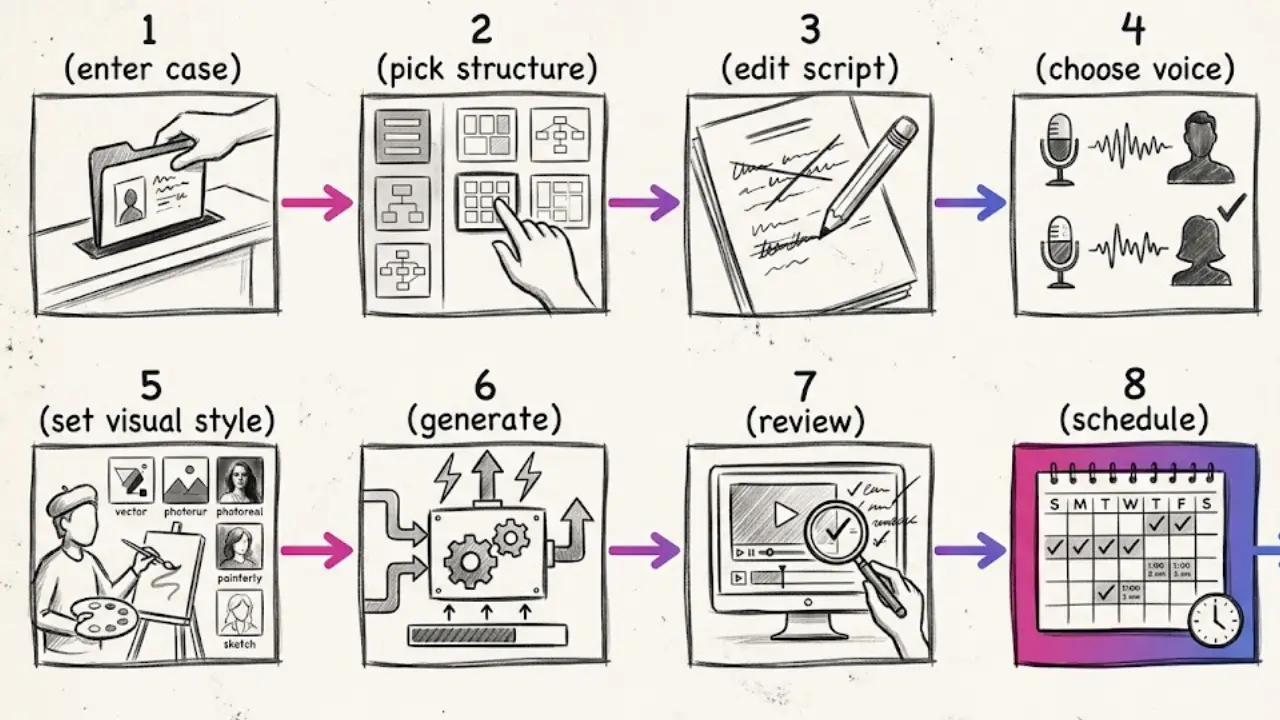
- Start a new video and enter your case. Type your topic or paste a script you have already researched. If you are starting from an idea, the AI drafts a first script you can edit line by line.
- Pick a structure. Choose one of the built-in structures that matches your format, for example a timeline or a hook-driven explainer. This sets the pacing before a single word is narrated.
- Tighten the script. Edit the opening line until it grabs, cut anything that slows the middle, and make sure every claim is something you can stand behind. This is the step that separates a real channel from AI filler.
- Choose your narrator voice. Audition a few of the 200+ voices, pick a calm authoritative one, and reuse it for every episode so the channel sounds consistent.
- Set the visual style. Select a dark cinematic style from the 39 available and let the tool generate visuals that match each scene of your script.
- Generate the video. Faceless Lab assembles the script, voiceover, visuals, music, and captions into a finished, publish-ready video, usually in a few minutes.
- Review before it goes out. Watch it once. Check that the captions are accurate, the facts are right, and the tone is respectful.
- Schedule it. Set it to publish on your posting rhythm, or batch several cases and let Faceless Lab space them out across the week.
Batching tip. True crime is perfect for batching because the format repeats. Research five cases in one sitting, run them through the same structure and voice, and you have a week of content in an afternoon. Autopilot (currently in beta) can take this further by helping keep the pipeline moving with less manual setup.
6. Where Faceless Lab is and isn't the right choice
I would rather you start on the right foot than feel misled, so here is the honest version.
Faceless Lab is a strong fit when:
- You want to publish true crime Shorts and videos on a consistent schedule without editing each one by hand.
- You are happy to do your own research and writing, and you want the tool to handle voice, visuals, music, captions, and scheduling.
- You want one consistent voice and look across a whole series.
- You want to run more than one channel or platform from a single workflow.
Faceless Lab is not the right tool when:
- You want long-form investigative documentaries with archival footage licensing and original interviews. That is a different kind of production.
- You expect the AI to do the research and fact-checking for you. It will draft, but the accuracy and the original angle have to come from you.
- You want fully automatic posting to TikTok with zero involvement. TikTok is excluded from fully automatic auto-publish and needs your explicit consent for each post, so that one stays partly manual.
Being clear about this is the point. The tool makes production fast. It does not replace your judgment, and in true crime that judgment is the whole game.
7. Publish on a schedule and keep the channel monetizable
Growth in this niche comes from rhythm and trust. One brilliant video a month loses to three solid videos a week, because the algorithm rewards consistency and each upload is another chance to be discovered.
What keeps a true crime channel healthy:
- Post on a set cadence. Pick a realistic schedule and hold it. Batching plus scheduling inside Faceless Lab is how you keep the rhythm without burning out.
- Add real value. Platforms in 2026 are actively demoting low-effort, mass-produced AI content. Your research, your framing, and your accuracy are what mark your videos as worth watching and worth monetizing.
- Keep it advertiser-friendly. Handle graphic details with restraint. A respectful, factual tone protects both the people in the story and your revenue.
- Turn viewers into subscribers. End on the next case or the open question so people come back for the follow-up.
True crime is one of the best places to start a faceless channel right now, because the format is made for narration and atmosphere, the source material never runs dry, and the audience is enormous. The creators who win are the ones who treat the tools as a production line and their own research and taste as the product. Faceless Lab handles the script drafting, narration, visuals, music, captions, and scheduling so you can spend your time on the part that actually matters, which is finding good cases and telling them well.
Start free, build your first case, and see a finished video before you decide anything. If it helps you, the best thank-you is a repost so another creator finds it, and if you want to earn while you share it, our affiliate program pays you for every creator you send our way.
Try it and make your first faceless true crime video today: https://facelesslab.video/
Read more
Frequently asked questions
How do you make faceless true crime videos without showing your face?
You build the video around narration and visuals instead of a presenter. Research a real case, write a tight script, and use a text-to-speech narrator voice to read it. Then add dark cinematic visuals, a low background music bed, and synced captions. A tool like Faceless Lab does the assembly for you: you enter or paste the script, pick a voice and a visual style, and it generates a finished video with voiceover, visuals, music, and captions in a few minutes. Your face and your real voice never appear, so the channel stays completely anonymous while still feeling like a real documentary show.
Is true crime a good niche for a faceless channel in 2026?
Yes, it is one of the strongest. True crime has a huge, loyal audience, the format is built for narration rather than a host, and the supply of cases is effectively endless. It is also frequently cited among the higher-earning categories, though exact RPM depends on your audience and how advertiser-friendly your content is. The trade-off is that it is competitive and easy to do badly. Channels that add real research, an original angle, and a respectful tone stand out, while copy-paste summaries over stock footage get ignored and increasingly demonetized.
Can AI write my true crime scripts for me?
It can draft them, and that saves real time, but you should not publish a raw AI draft unedited. Use the AI to produce a first version and a structure, then do the work that matters: check the facts against public reporting, cut anything you cannot stand behind, sharpen the opening line, and add your own framing. In true crime, accuracy and judgment are the whole product. The safest workflow is to research the case yourself, let the tool help you shape and pace the script, and then narrate it with a consistent voice.
What length works best for faceless true crime videos?
It depends on the format. Unsolved-mystery teasers and hook-driven cases work as 30 to 60 second Shorts and Reels, which are ideal for fast growth and comment-driven reach. Timeline breakdowns and "what really happened" explainers suit longer videos, from around 60 seconds up to several minutes, where a clear sequence keeps people watching to the resolution. A good approach is to test short cases first to find what your audience responds to, then expand the strongest ones into longer episodes. Consistency of format matters more than any single ideal length.
Will a faceless true crime channel get demonetized?
It can, if you make low-effort or graphic content. Platforms in 2026 actively demote mass-produced AI videos with no added value, and overly graphic or exploitative content is not advertiser-friendly. You reduce the risk by adding genuine research and original framing, handling sensitive details with restraint, keeping a respectful tone toward victims and families, and sticking to what public reporting and court records support. Done this way, true crime is a well-established, monetizable category. The tools speed up production, but the editorial care is what keeps a channel eligible to earn.
How many true crime videos should I post per week?
Enough to stay consistent without burning out. For most creators that means three to five short videos a week, or two to three longer ones. Consistency beats occasional perfection, because the algorithm rewards a steady rhythm and every upload is another chance to be found. The realistic way to keep that pace is to batch: research several cases in one sitting, run them through the same structure and narrator voice, and schedule them to publish across the week. Faceless Lab's scheduling lets you set the cadence once and keep the channel active automatically.
Related articles
Faceless YouTube Automation, the Honest Way to Run a Channel on a System
Faceless YouTube automation is a production system, not passive income. Here is what it really takes to run a channel that keeps posting, and how we do it.
Build a Faceless Book Summary Channel Without Reading on Camera
Start a faceless book summary channel with AI. Pick the right books, script summaries that hold attention, publish on a daily rhythm, and turn quiet reading into a channel that grows.
Build a Faceless Sleep and Meditation Channel That Runs While You Rest
Sleep and meditation is one of the calmest faceless niches to run. Here is how to make relaxing videos with AI voice, visuals and music, then publish them on a rhythm.